
Depth 12 · Captured moon
Triton
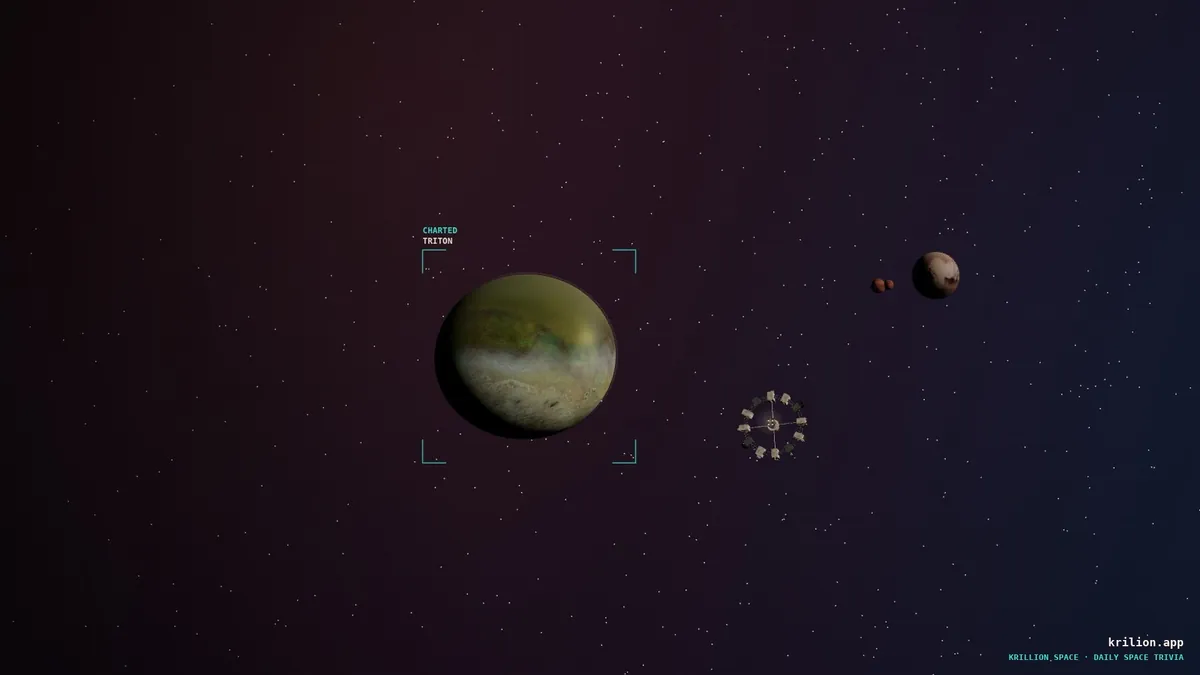
Triton is Neptune's largest moon and the only large moon in the solar system that orbits backward, against its planet's spin. Scientists think it began as a Kuiper Belt object that Neptune captured, which makes it a close cousin of Pluto.
Fact sheet
- Type
- Moon
- Moon of
- Neptune
- Distance
- About 354,760 km (220,440 miles) from Neptune; Neptune orbits about 4.5 billion km (2.8 billion miles), or 30 AU, from the Sun
- Size
- Diameter about 2,700 km (1,680 miles)
- Discovered
- Discovered 10 October 1846 by William Lassell
- On the voyage
- Depth 12, in the Outer Sol section of the route, between Neptune and Pluto
Things to know
- Triton circles Neptune in the opposite direction to the planet's rotation, completing one backward orbit in about 5.9 days. NASA NSSDC
- Voyager 2 measured surface temperatures of about -235°C (-391°F), among the coldest found anywhere in the solar system. NASA
- Voyager 2 caught active geysers on Triton in 1989, showing it is one of the few geologically active moons. NASA
- Its surface is a crust of frozen nitrogen that reflects about 70 percent of the sunlight that reaches it. NASA
- William Lassell found Triton on 10 October 1846, just 17 days after Neptune itself was discovered. NASA
Missions
Voyager 2 is the only spacecraft to have visited Triton, photographing about two-thirds of its surface during the August 1989 Neptune flyby.
Sources
Reach depth 12 on a voyage to fly past Triton yourself. Every right answer warps your ship one stop deeper.
Play Krillion Space