
Depth 13 · Dwarf planet
Pluto
Pluto is a dwarf planet in the Kuiper Belt, a zone of icy bodies beyond Neptune, and was counted as the ninth planet from its discovery in 1930 until 2006. New Horizons revealed it as a surprisingly active world with nitrogen glaciers, tall mountains and a thin, hazy atmosphere.
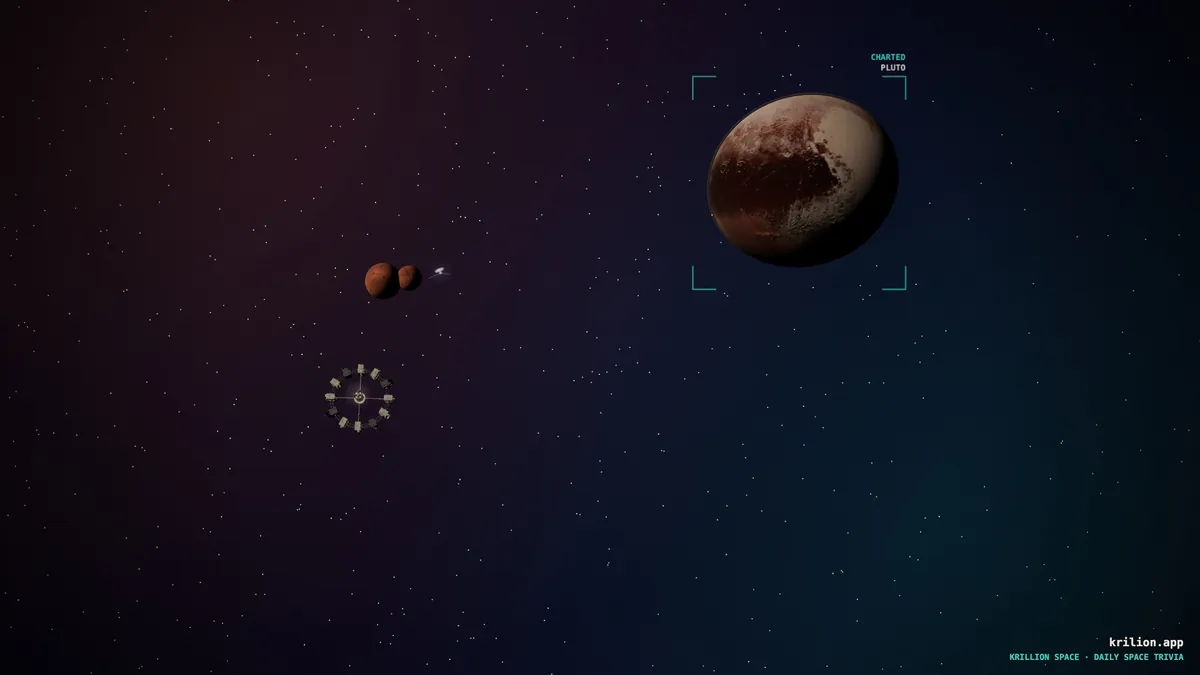
Fact sheet
- Type
- Dwarf planet
- Distance
- About 5.9 billion km (3.7 billion miles), or 39.5 AU, from the Sun on average, ranging from about 30 to 49 AU
- Size
- Diameter about 2,377 km (1,477 miles), about two-thirds as wide as Earth's Moon
- Discovered
- Discovered 18 February 1930 by Clyde Tombaugh
- On the voyage
- Depth 13, in the Outer Sol section of the route, between Triton and Arrokoth
Things to know
- Pluto's bright heart includes Sputnik Planitia, a glacier of nitrogen ice about 1,000 km (600 miles) wide. NASA
- Its largest moon, Charon, is about half Pluto's size, and the two keep the same faces turned toward each other as they turn every 153 hours. NASA
- One trip around the Sun takes Pluto about 248 Earth years, on an oval path that swings between about 30 and 49 AU from the Sun. NASA
- Pluto has mountains about 2 to 3 km (6,500 to 9,800 feet) tall and surface temperatures around -226 to -240°C (-375 to -400°F). NASA
- The International Astronomical Union reclassified Pluto as a dwarf planet in 2006. NASA
Missions
NASA's New Horizons is the only spacecraft to visit Pluto, flying about 7,800 km (4,800 miles) above its surface on 14 July 2015.
Sources
Reach depth 13 on a voyage to fly past Pluto yourself. Every right answer warps your ship one stop deeper.
Play Krillion Space