
Depth 14 · Kuiper Belt object
Arrokoth
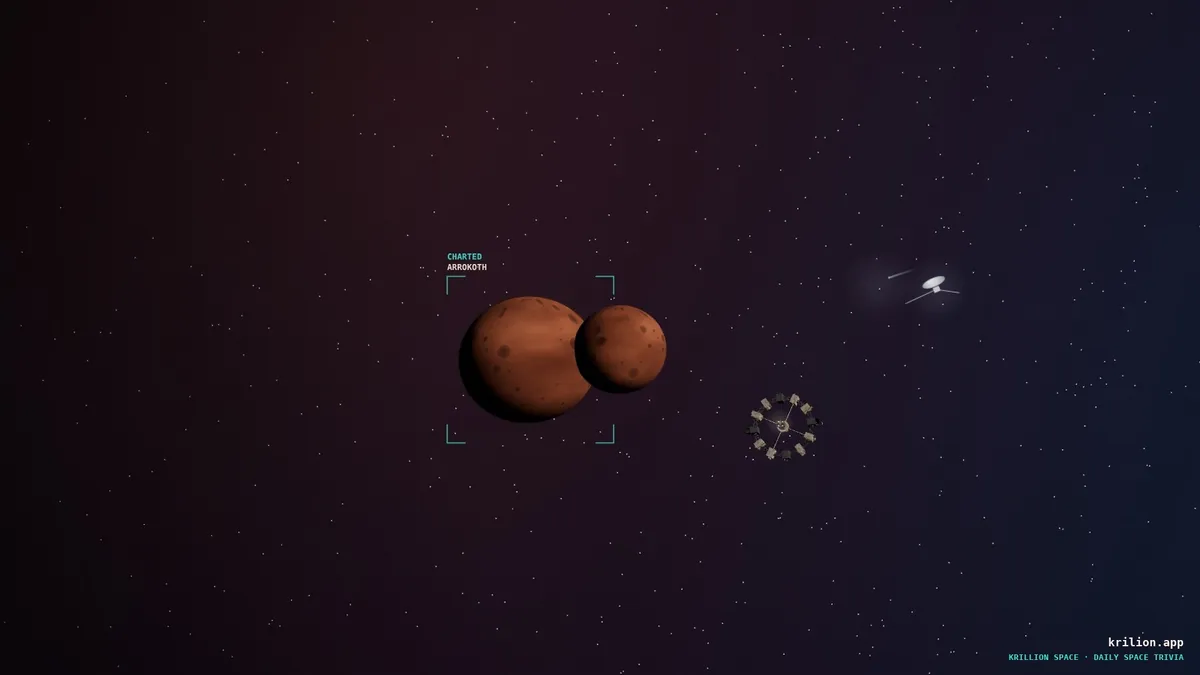
Arrokoth is a small, red, two-lobed body in the Kuiper Belt and the most distant object any spacecraft has explored up close. Because it has changed little since the solar system formed, it works as a time capsule showing how the first building blocks of planets came together.
Fact sheet
- Type
- Kuiper Belt object (contact binary)
- Distance
- About 6.5 billion km (4 billion miles), or 44.6 AU, from the Sun on average
- Size
- About 35 km long, 20 km wide and 10 km thick (22 × 12 × 6 miles)
- Discovered
- Discovered 26 June 2014 by Marc Buie of the New Horizons team, using the Hubble Space Telescope
- On the voyage
- Depth 14, in the Outer Sol section of the route, between Pluto and Voyager 1
Things to know
- New Horizons flew past Arrokoth on 1 January 2019, coming within about 3,538 km (2,198 miles) of it. NASA
- Arrokoth is a contact binary: two flattened lobes that formed separately and later merged at no more than a couple of meters per second. NASA
- It is redder than Pluto and the reddest outer solar system object yet visited by a spacecraft, with signs of methanol and organic molecules on its surface. NASA
- Its name means sky in the Powhatan/Algonquian language and was announced on 12 November 2019 with the consent of Powhatan Tribal elders; the team had earlier nicknamed it Ultima Thule. NASA
- It spins once every 15.92 hours and its axis is tipped about 98 degrees relative to its orbit. NASA
Missions
Discovered with the Hubble Space Telescope in 2014, Arrokoth was visited by NASA's New Horizons on 1 January 2019.
Sources
- NASA – Arrokoth Facts
- NASA – Arrokoth Revealed: A First In-Depth Look at a Pristine World
- NASA – Kuiper Belt flyby object officially named Arrokoth
- NASA – New Horizons
Reach depth 14 on a voyage to fly past Arrokoth yourself. Every right answer warps your ship one stop deeper.
Play Krillion Space