
Depth 15 · Probe, launched 1977
Voyager 1
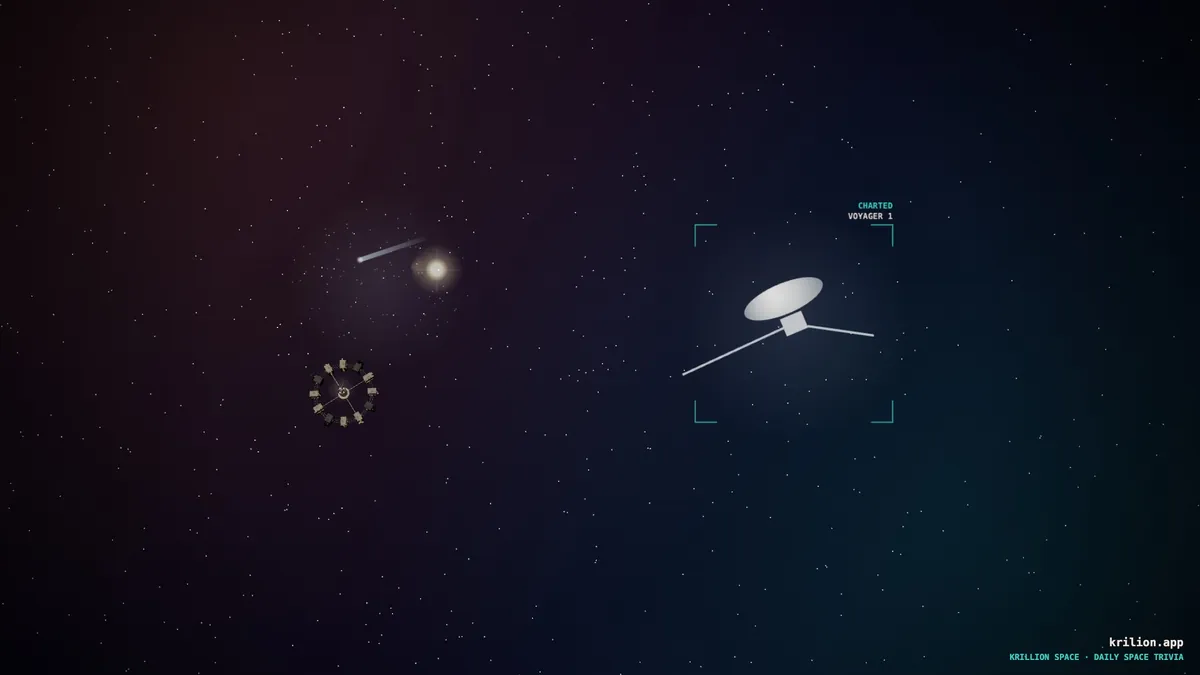
Voyager 1 is a NASA probe launched in 1977 that flew past Jupiter and Saturn and is now the most distant human-made object. In 2012 it became the first spacecraft to leave the heliosphere, the bubble of solar wind around the Sun, and it still sends back data from interstellar space.
Fact sheet
- Type
- Space probe
- Distance
- About 25.9 billion km (16.1 billion miles) from Earth in November 2026; NASA expects it to be one light-day away on 18 November 2026, the first human-made object to get that far
- Size
- Launch mass about 722 kg (1,592 lb); a 3.66 m (12 ft) high-gain dish antenna sits atop a 1.78 m wide ten-sided body, with a 13 m magnetometer boom
- Discovered
- Launched 5 September 1977 by NASA
- On the voyage
- Depth 15, in the Outer Sol section of the route, between Arrokoth and the Oort Cloud
Things to know
- Voyager 1 launched from Cape Canaveral on 5 September 1977 aboard a Titan IIIE-Centaur rocket. NASA
- It passed Jupiter on 5 March 1979, finding a faint ring and two small moons, then flew by Saturn on 12 November 1980. NASA
- On 17 February 1998, at about 69.4 AU, it overtook Pioneer 10 to become the most distant human-made object. NASA
- It carries a gold-plated copper record with greetings in 55 languages, natural sounds, 90 minutes of music and 115 images. NASA
- At one light-day out, a radio signal takes about 24 hours each way, so a command and its reply take about two days. NASA JPL
Sources
- NASA – Voyager 1
- NASA – Voyager 1: What Is a Light-Day
- JPL – Voyager 1 conserves power, resolves brief communications pause (29 Oct 2026)
- NSSDC – Voyager 1 spacecraft details
Reach depth 15 on a voyage to fly past Voyager 1 yourself. Every right answer warps your ship one stop deeper.
Play Krillion Space