
Depth 11 · Ice giant
Neptune
Neptune is the eighth and farthest known planet from the Sun, a dark, cold ice giant with the fastest winds measured in the solar system. It was the first planet located through mathematical prediction rather than by scanning the sky.
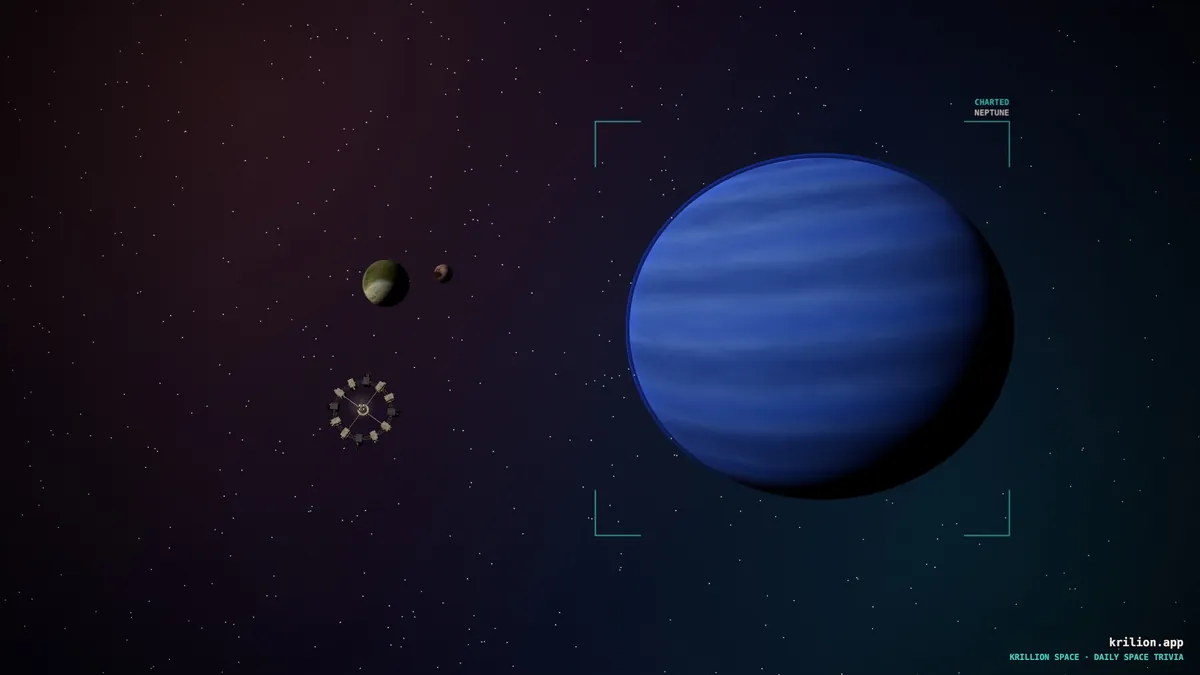
Fact sheet
- Type
- Ice giant planet
- Distance
- About 4.5 billion km (2.8 billion miles), or 30 AU, from the Sun on average
- Size
- Equatorial diameter about 49,528 km (30,775 miles), about four times as wide as Earth
- Discovered
- Discovered 23 September 1846 by Johann Galle, using Urbain Le Verrier's prediction
- On the voyage
- Depth 11, in the Outer Sol section of the route, between Uranus and Triton
Things to know
- Urbain Le Verrier predicted Neptune's position from wobbles in Uranus's orbit, and Johann Galle found it in 1846 on his first night of searching. NASA
- Winds on Neptune top 2,000 km/h (1,200 mph), about three times faster than Jupiter's strongest winds. NASA
- One orbit of the Sun takes about 165 Earth years, so each of Neptune's four seasons lasts more than 40 years. NASA
- Voyager 2 came within about 4,800 km (2,980 miles) of Neptune's cloud tops in 1989, the closest of its four planetary flybys. NASA
- A storm called the Great Dark Spot, big enough to hold Earth, was seen in 1989 but has since vanished while new storms have appeared. NASA
Missions
Voyager 2 is the only spacecraft to have visited Neptune, flying past on 25 August 1989.
Sources
Reach depth 11 on a voyage to fly past Neptune yourself. Every right answer warps your ship one stop deeper.
Play Krillion Space