
Depth 09 · Hazy moon
Titan
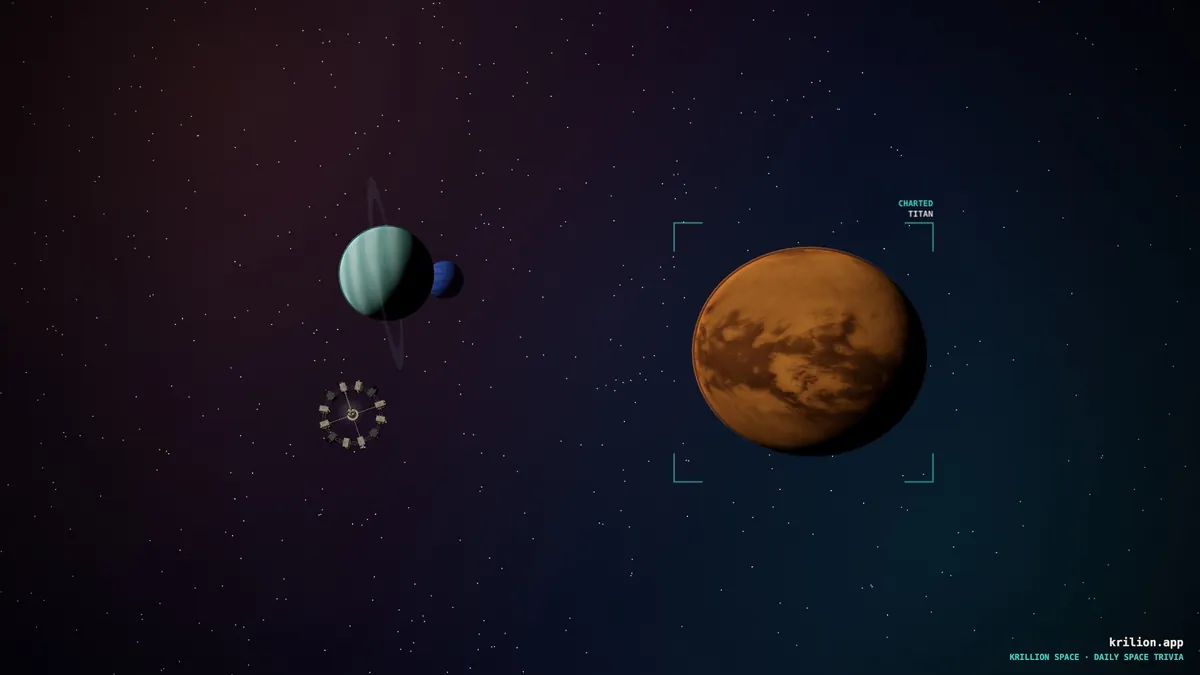
Titan is Saturn's largest moon and the second-largest moon in the solar system, wrapped in a thick nitrogen haze. It is the only moon with a substantial atmosphere and the only place besides Earth known to have liquid on its surface, in the form of methane and ethane rivers, lakes and seas.
Fact sheet
- Type
- Moon
- Moon of
- Saturn
- Distance
- About 1.2 million km (759,000 miles) from Saturn; Saturn orbits about 1.4 billion km (886 million miles), or 9.5 AU, from the Sun
- Size
- Diameter about 5,150 km (3,200 miles), nearly 50% wider than Earth's Moon
- Discovered
- Discovered 25 March 1655 by Christiaan Huygens
- On the voyage
- Depth 9, in the Outer Sol section of the route, between Enceladus and Uranus
Things to know
- Titan's air is about 95% nitrogen and 5% methane, and the pressure at its surface is about 60% higher than at sea level on Earth. NASA
- The surface sits at about -179°C (-290°F), cold enough for methane and ethane to rain down and pool as liquid. NASA
- Gravity measurements by Cassini point to a global ocean of salty liquid water hidden about 55 to 80 km (35 to 50 miles) beneath the icy crust. NASA
- On 14 January 2005, ESA's Huygens probe touched down on Titan, the first landing ever made in the outer solar system. ESA
- NASA's Dragonfly rotorcraft is set to launch no earlier than July 2028 and reach Titan in late 2034 to fly between sites and study prebiotic chemistry. NASA
Missions
Pioneer 11 flew through the Saturn system in 1979, Voyager 1 passed in 1980, the NASA-ESA-ASI Cassini-Huygens mission studied Titan from 2004 to 2017 and landed the Huygens probe in 2005, and NASA's Dragonfly is planned to launch in 2028.
Sources
- NASA – Titan Facts
- NSSDC – Saturnian Satellite Fact Sheet
- ESA – Huygens lands on Titan
- NASA – Dragonfly mission
Reach depth 9 on a voyage to fly past Titan yourself. Every right answer warps your ship one stop deeper.
Play Krillion Space