
Depth 08 · Geyser moon
Enceladus
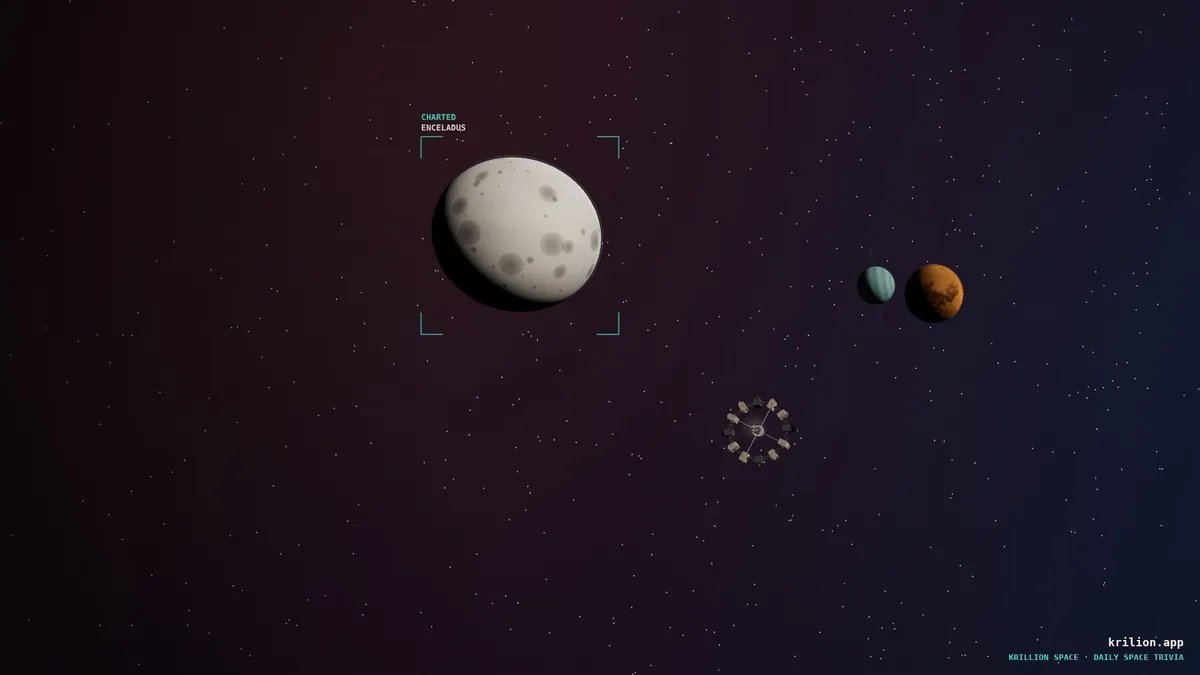
Enceladus is a small, icy moon of Saturn with the most reflective surface in the solar system. Jets from its south pole spray water from a global underground ocean into space, letting spacecraft sample that ocean directly.
Fact sheet
- Type
- Icy moon
- Moon of
- Saturn
- Distance
- About 238,000 km (148,000 miles) from Saturn; Saturn orbits about 1.4 billion km (9.5 AU) from the Sun
- Size
- Diameter about 500 km (310 miles), roughly as wide as Arizona
- Discovered
- Discovered 1789 by William Herschel
- On the voyage
- Depth 8, in the Outer Sol section of the route, between Saturn and Titan
Things to know
- Enceladus reflects more sunlight than any other body in the solar system, and its surface sits at about -201°C (-330°F). NASA
- In 2005 Cassini found jets of water vapor and ice erupting at about 1,300 km/h (800 mph) from warm cracks near the south pole nicknamed tiger stripes. NASA
- Material from these jets supplies Saturn's E ring, the ring Enceladus itself orbits within. NASA
- Gravity measurements show a global ocean under the ice, which averages about 20 to 25 km thick but may be only 1 to 5 km thick at the south pole. NASA
- Tiny silica grains from Enceladus suggest water and rock are reacting at above about 90°C (200°F), pointing to hydrothermal vents on the ocean floor. NASA
Missions
The Voyager spacecraft imaged its bright surface in the early 1980s, and Cassini discovered the plumes in 2005 and flew as close as about 25 km (16 miles) in 2008.
Sources
Reach depth 8 on a voyage to fly past Enceladus yourself. Every right answer warps your ship one stop deeper.
Play Krillion Space