
Depth 07 · Ringed giant
Saturn
Saturn is the sixth planet from the Sun and the second largest, a hydrogen and helium giant best known for its broad, bright rings. It has more confirmed moons than any other planet and is the farthest planet you can see without a telescope.
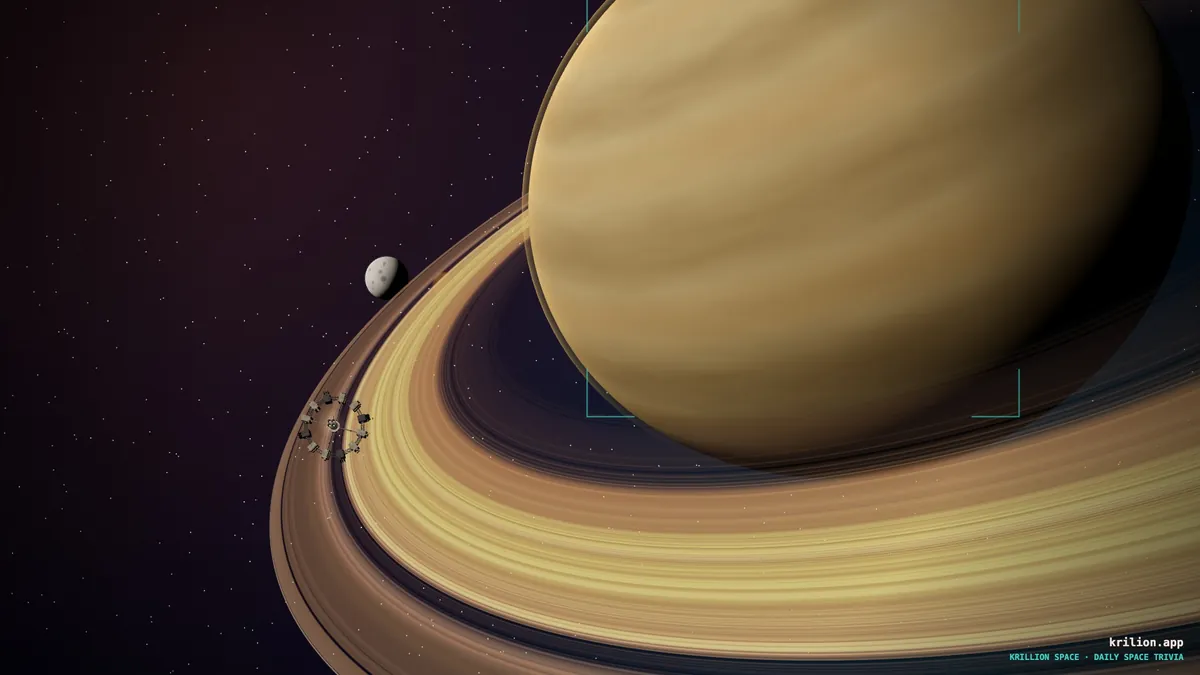
Fact sheet
- Type
- Gas giant
- Distance
- About 1.4 billion km (886 million miles), or 9.5 AU, from the Sun on average
- Size
- Diameter about 120,500 km (74,900 miles) at the equator, about 9 times Earth's
- Discovered
- Known since antiquity
- On the voyage
- Depth 7, in the Outer Sol section of the route, between Europa and Enceladus
Things to know
- Saturn's average density is lower than that of water, so in principle it would float in a big enough bathtub. NASA
- The rings reach up to 282,000 km (175,000 miles) from the planet, yet the main rings are typically only about 10 m (30 feet) thick. NASA
- Saturn has 274 confirmed moons as of March 2025, more than any other planet. NASA
- A six-sided jet stream about 30,000 km (20,000 miles) across circles Saturn's north pole. NASA
- A day on Saturn lasts about 10.7 hours, while one orbit of the Sun takes about 29.4 Earth years. NASA
Missions
Pioneer 11 reached Saturn first in 1979, followed by Voyager 1 (1980) and Voyager 2 (1981); Cassini orbited from 2004 to 2017, and its Huygens probe landed on the moon Titan in 2005.
Sources
Reach depth 7 on a voyage to fly past Saturn yourself. Every right answer warps your ship one stop deeper.
Play Krillion Space