
Depth 06 · Ice moon
Europa
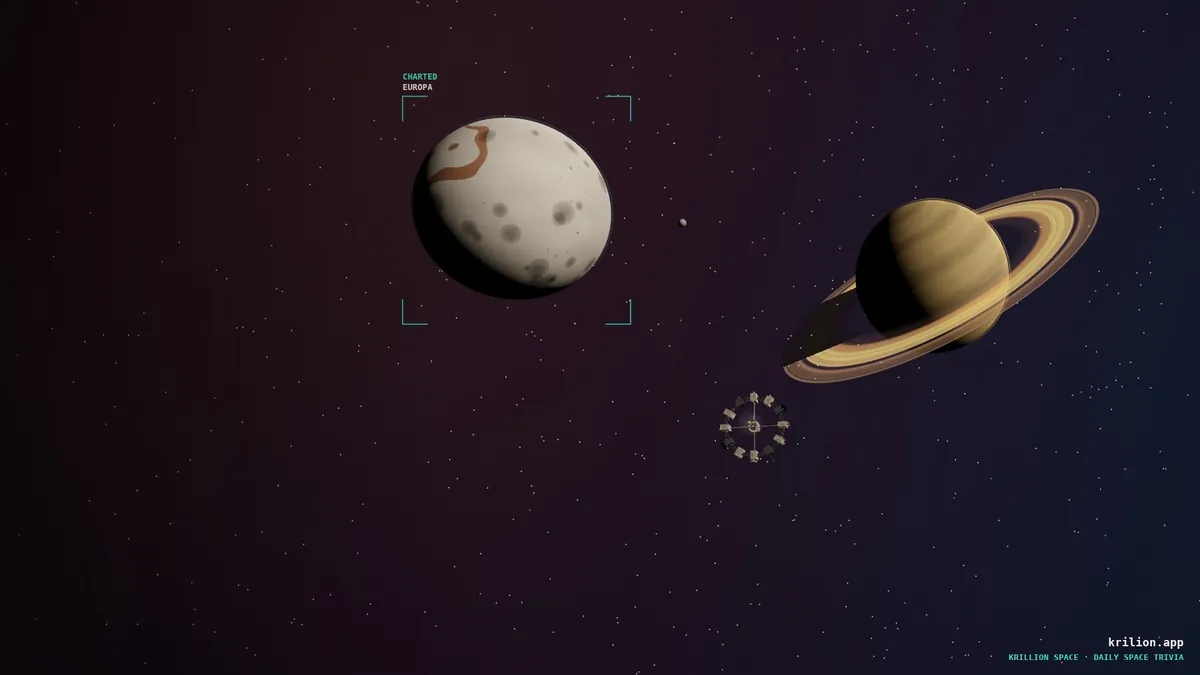
Europa is one of Jupiter's four large moons, covered by a shell of water ice. Beneath that shell lies a salty ocean thought to hold about twice as much water as all of Earth's oceans, making it one of the most promising places to look for life beyond Earth.
Fact sheet
- Type
- Icy Galilean moon
- Moon of
- Jupiter
- Distance
- About 671,000 km (417,000 miles) from Jupiter; Jupiter orbits about 778 million km (5.2 AU) from the Sun
- Size
- Diameter about 3,122 km (1,940 miles), about 90 percent of Earth's Moon
- Discovered
- Discovered 1610 by Galileo Galilei
- On the voyage
- Depth 6, in the Outer Sol section of the route, between Io and Saturn
Things to know
- Scientists estimate Europa's ice shell is about 15 to 25 km (10 to 15 miles) thick, sitting on an ocean about 60 to 150 km (40 to 100 miles) deep. NASA
- Europa orbits Jupiter about every 3.5 days, and it is locked in a rhythm with Io and Ganymede: Io makes four orbits and Europa two for each orbit of Ganymede. NASA
- Its surface is thought to be only about 40 to 90 million years old, very young compared with the billions of years of neighboring Callisto. NASA
- In 2019 a NASA-led team using the Keck Observatory detected water vapor above Europa's surface for the first time. NASA
- Europa's icy surface reflects about 5.5 times as much sunlight as Earth's Moon. NASA
Missions
Voyager 1 and 2 flew past in 1979, Galileo made 12 close flybys between 1995 and 2003, and Juno flew by in 2022; NASA's Europa Clipper launched in 2024 and is due at Jupiter in 2030, with ESA's Juice arriving in 2031.
Sources
Reach depth 6 on a voyage to fly past Europa yourself. Every right answer warps your ship one stop deeper.
Play Krillion Space