
Depth 05 · Volcanic moon
Io
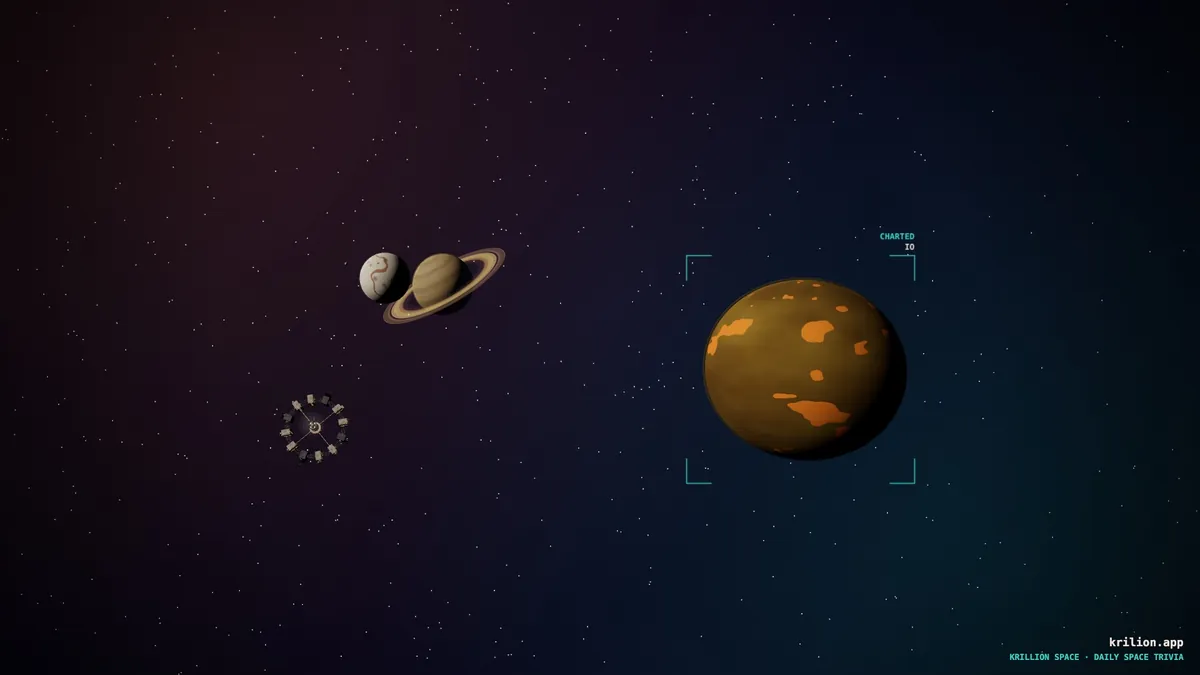
Io is the innermost of Jupiter's four large moons and the most volcanically active world in the solar system. Constant gravitational squeezing from Jupiter and its neighboring moons heats its interior and powers hundreds of volcanoes.
Fact sheet
- Type
- Galilean moon
- Moon of
- Jupiter
- Distance
- About 422,000 km (262,000 miles) from Jupiter; Jupiter orbits about 778 million km (5.2 AU) from the Sun
- Size
- Diameter about 3,643 km (2,264 miles), slightly larger than Earth's Moon
- Discovered
- Discovered 1610 by Galileo Galilei
- On the voyage
- Depth 5, in the Outer Sol section of the route, between Jupiter and Europa
Things to know
- Galileo Galilei discovered Io on January 8, 1610, after likely seeing it the night before without being able to separate it from Europa. NASA
- Io has hundreds of volcanoes, some throwing lava fountains dozens of kilometers high, and fresh lava keeps repaving its surface. NASA
- Timed pulls from Europa and Ganymede stretch Io's orbit, making its solid surface rise and fall by up to 100 m (330 feet). NASA
- Io circles Jupiter in about 1.77 days, keeping the same face toward the planet. NASA NSSDC
- Io sheds about 1 tonne of material every second, which forms a ring of charged gas around Jupiter and helps inflate the planet's magnetic bubble. NASA
Missions
Voyager 1 found the first signs of Io's volcanoes in 1979, Galileo provided most of what we know while orbiting Jupiter from 1995 to 2003, and Juno has made close passes, including one on Dec. 30, 2023.
Sources
Reach depth 5 on a voyage to fly past Io yourself. Every right answer warps your ship one stop deeper.
Play Krillion Space