
Depth 04 · Gas giant
Jupiter
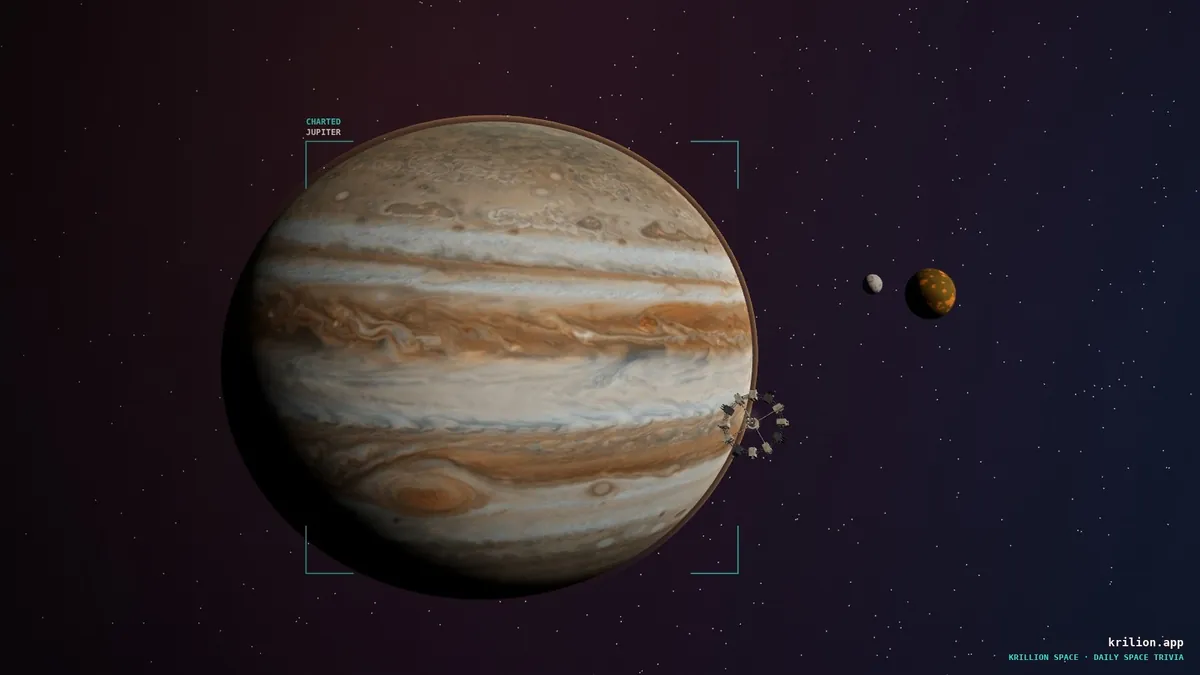
Jupiter is the largest planet in the solar system, a giant ball of mostly hydrogen and helium with no solid surface. It has more than 300 times Earth's mass, a storm larger than Earth, and a large family of moons that includes Ganymede, the biggest moon in the solar system.
Fact sheet
- Type
- Gas giant
- Distance
- About 778 million km (484 million miles), or 5.2 AU, from the Sun on average
- Size
- Diameter about 142,984 km (88,846 miles) at the equator, about 11 times Earth's
- Discovered
- Known since antiquity
- On the voyage
- Depth 4, in the Inner Sol section of the route, between Ceres and Io
Things to know
- Jupiter spins once in about 9.9 hours, the shortest day of any planet, but takes about 12 Earth years to orbit the Sun. NASA
- Jupiter's mass is about 318 times Earth's. NASA NSSDC
- The Great Red Spot is a storm about twice Earth's width that has been watched for more than 300 years, and Juno's gravity data show it reaches about 500 km (300 miles) deep. NASA
- Deep inside, hydrogen is squeezed into an electrically conducting liquid metal, and Juno found the core is larger and fuzzier than expected, partly mixed into its surroundings. NASA
- Eight cyclones form an octagon around Jupiter's north pole, while five form a pentagon at the south pole. NASA
Missions
Pioneer 10 (1973), Pioneer 11 (1974) and Voyager 1 and 2 (1979) flew past, Galileo orbited until 2003, Cassini passed by in 2000, and Juno has orbited since 2016; NASA's Europa Clipper is due in 2030 and ESA's Juice in 2031.
Sources
Reach depth 4 on a voyage to fly past Jupiter yourself. Every right answer warps your ship one stop deeper.
Play Krillion Space