
Depth 03 · Asteroid belt
Ceres
Ceres is the largest object in the asteroid belt between Mars and Jupiter and the only dwarf planet in the inner solar system. It may be up to 25 percent water, and NASA's Dawn spacecraft found salt deposits left by briny water rising from below its surface.
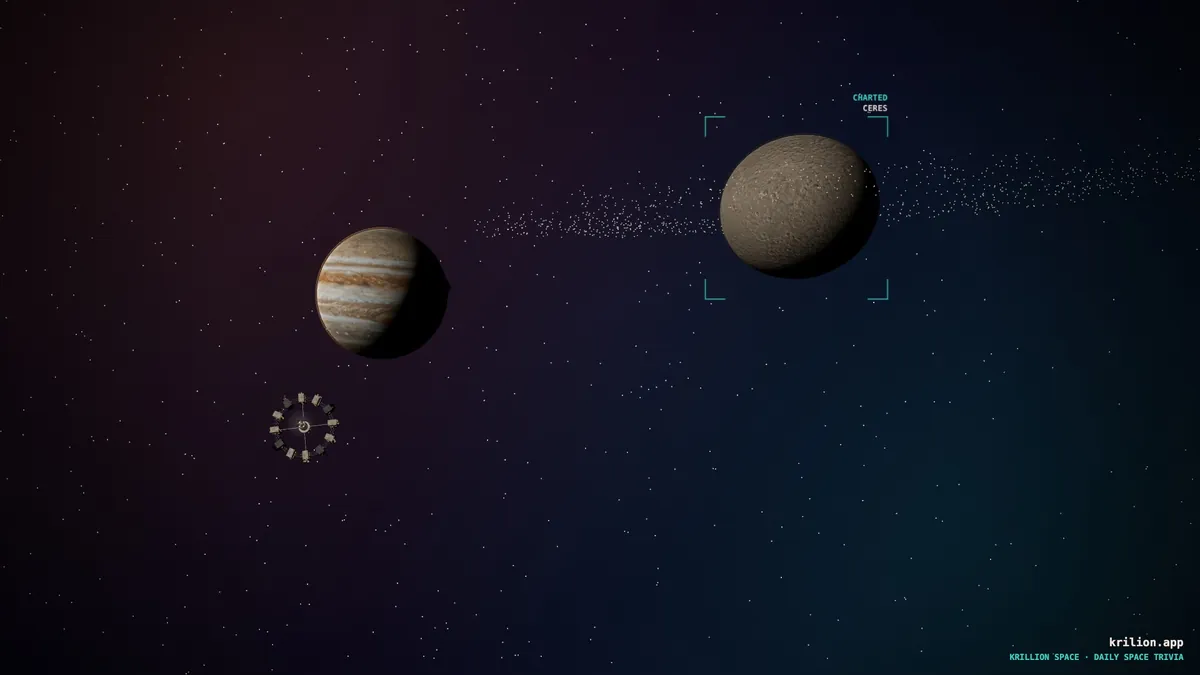
Fact sheet
- Type
- Dwarf planet
- Distance
- About 413 million km (257 million miles), or 2.8 AU, from the Sun on average
- Size
- Diameter about 952 km (592 miles), about one-thirteenth of Earth's
- Discovered
- Discovered 1801 by Giuseppe Piazzi
- On the voyage
- Depth 3, in the Inner Sol section of the route, between Mars and Jupiter
Things to know
- Giuseppe Piazzi spotted Ceres in 1801, the first object ever found in the asteroid belt; it was called an asteroid for many years before being classed as a dwarf planet in 2006. NASA
- Ceres alone holds about a quarter of the asteroid belt's total mass. NASA
- Ceres spins once in about 9 hours, one of the shortest days in the solar system, and takes about 4.6 Earth years to orbit the Sun. NASA
- The bright spots in the 92 km (57 mile) wide Occator Crater are mostly sodium carbonate, left behind by salty water from a reservoir about 40 km (25 miles) below the surface. NASA JPL
- Dawn was the first spacecraft to visit a dwarf planet and the first to orbit two different destinations beyond Earth, the asteroid Vesta and then Ceres. NASA JPL
Missions
NASA's Dawn spacecraft orbited Vesta from 2011 and then Ceres from March 6, 2015, until it ran out of fuel in 2018.
Sources
- NASA – Ceres: Facts
- NASA – Ceres
- NASA JPL – Bright Areas on Ceres Come From Salty Water Below
- NASA JPL – Dawn Mission Comes to End
Reach depth 3 on a voyage to fly past Ceres yourself. Every right answer warps your ship one stop deeper.
Play Krillion Space