
Depth 02 · Desert world
Mars
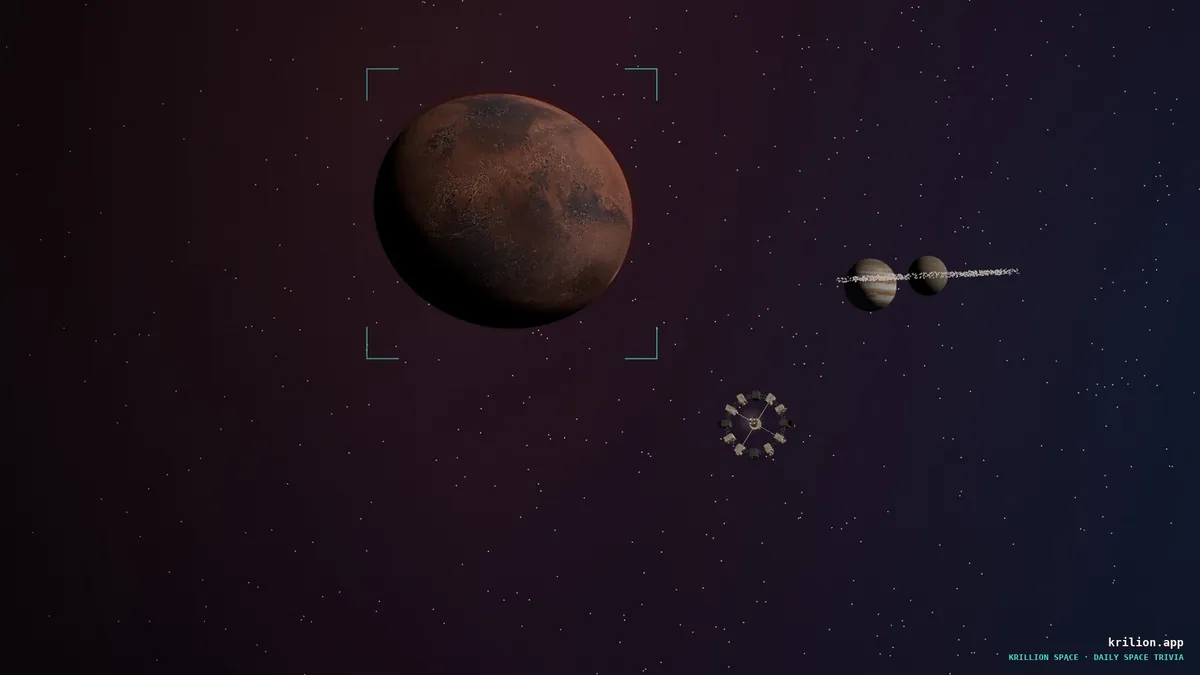
Mars is the fourth planet from the Sun, a cold desert world with a thin atmosphere made mostly of carbon dioxide. Ancient river valleys, deltas and lakebeds show that liquid water once flowed there, and water ice still lies just below the surface near the poles.
Fact sheet
- Type
- Terrestrial planet
- Distance
- About 228 million km (142 million miles), or 1.52 AU, from the Sun on average
- Size
- Diameter about 6,779 km (4,212 miles), about half Earth's
- Discovered
- Known since antiquity
- On the voyage
- Depth 2, in the Inner Sol section of the route, between the Moon and Ceres
Things to know
- A Martian day, called a sol, lasts about 24.6 hours, while a Martian year lasts 687 Earth days. NASA
- Olympus Mons is the largest volcano in the solar system, rising more than 40 km (25 miles) with a base about the size of Arizona. NASA
- The Valles Marineris canyon system stretches about 3,870 km (2,400 miles) and reaches about 9.3 km (5.8 miles) deep. NASA
- The planet looks red because iron minerals in its rocks and dust have rusted. NASA
- Mars's larger moon, Phobos, is expected to crash into the planet or break apart in about 50 million years. NASA
Missions
Mariner 4 made the first close flyby in 1965 and Viking 1 landed in 1976; orbiters such as Mars Odyssey (2001) and Mars Reconnaissance Orbiter (2006) followed, and the Curiosity (2012) and Perseverance (2021) rovers landed on the surface.
Sources
Reach depth 2 on a voyage to fly past Mars yourself. Every right answer warps your ship one stop deeper.
Play Krillion Space