
Depth 01 · Rocky moon
Moon
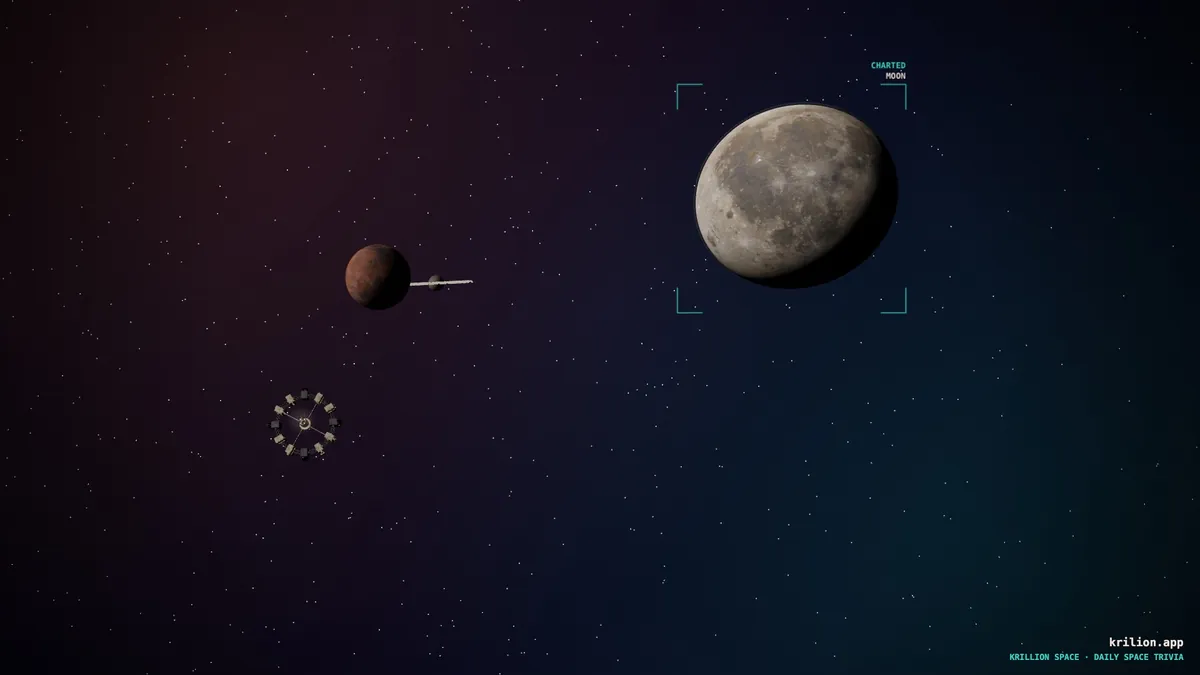
The Moon is Earth's only natural satellite, a rocky world a little over a quarter of Earth's width. It is the only place beyond Earth that people have walked on, and its rocks preserve a record of the early solar system.
Fact sheet
- Type
- Natural satellite
- Moon of
- Earth
- Distance
- About 384,400 km (238,855 miles) from Earth on average; Earth orbits about 150 million km (1 AU) from the Sun
- Size
- Diameter about 3,475 km (2,160 miles), a little over a quarter of Earth's
- Discovered
- Known since antiquity
- On the voyage
- Depth 1, in the Inner Sol section of the route, between Earth and Mars
Things to know
- The Moon takes about 27.3 days to orbit Earth, but a full cycle of phases takes about 29.5 days because Earth is moving around the Sun at the same time. NASA NSSDC
- The Moon is drifting away from Earth by about 3.8 cm (1.5 inches) each year. NASA NSSDC
- The leading explanation for its origin is that a Mars-sized body crashed into the young Earth and the debris came together to form the Moon. NASA
- Ice is concentrated in permanently shadowed craters near the poles, and in 2020 the SOFIA airborne observatory confirmed water on the sunlit surface in Clavius Crater. NASA
- With no thick atmosphere to hold heat, surface temperatures swing from about 127°C (260°F) in sunlight to about -173°C (-280°F) in darkness. NASA
Missions
Apollo 11 made the first crewed landing in 1969 and Apollo 17 the last of six in 1972, returning about 382 kg (842 pounds) of samples; India's Chandrayaan-1 detected signs of water across the surface in 2008, and more than 105 robotic spacecraft have been sent to the Moon.
Sources
Reach depth 1 on a voyage to fly past the Moon yourself. Every right answer warps your ship one stop deeper.
Play Krillion Space