
Depth 39 · Pillars of Creation
Eagle Nebula
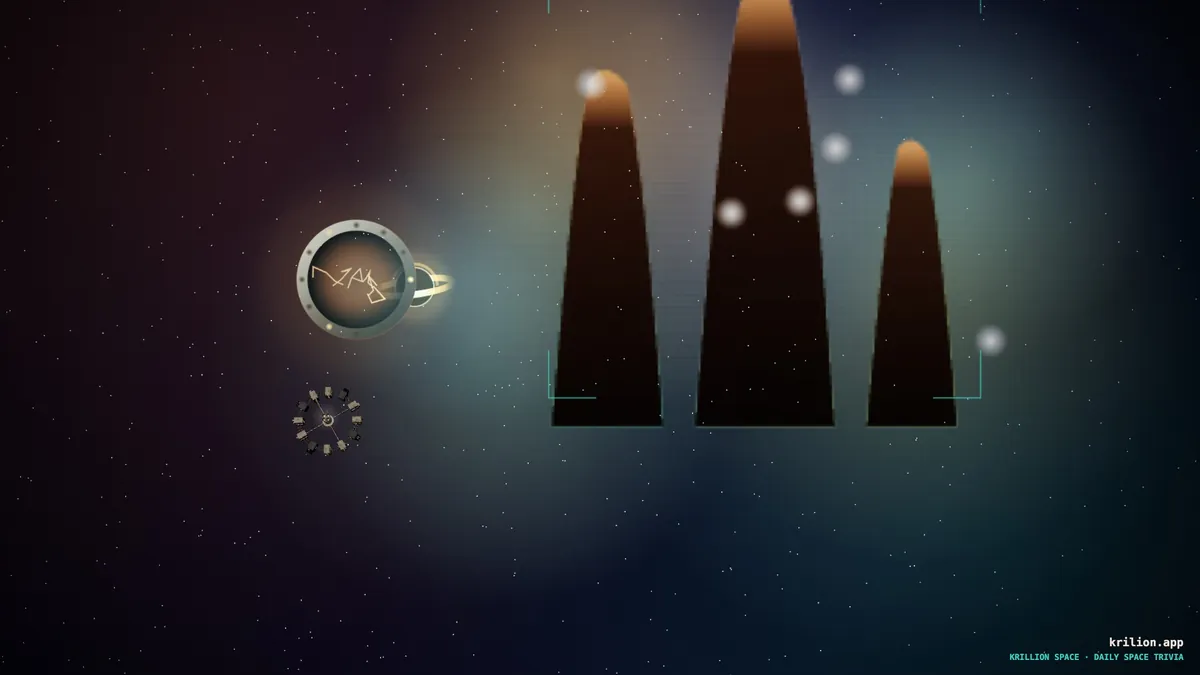
The Eagle Nebula is a large cloud of glowing gas and dust lit up by a cluster of young, hot stars. A small part of it holds the Pillars of Creation, towers of cold gas where new stars are still forming, made famous by Hubble and later by Webb.
Fact sheet
- Type
- Emission nebula with a young open star cluster
- Distance
- About 6,500 to 7,000 light-years from Earth
- Size
- About 70 by 55 light-years
- Constellation
- Serpens
- Position in the sky
- Right ascension 18h 19m, declination −13° 49′
- Seeing it from Earth
- Its star cluster shows up in a small telescope (the whole object is about magnitude 6), best seen around August, but seeing the Pillars themselves needs a large telescope and excellent conditions.
- On the voyage
- Depth 39, in the Milky Way section of the route, between the Crab Nebula and Cygnus X-1
Things to know
- Messier 16 is really two objects in one: a glowing gas cloud (IC 4703) and the young star cluster NGC 6611 whose light makes it shine. NASA
- Swiss astronomer Jean-Philippe Loys de Chéseaux discovered it in 1745. NASA
- The Pillars of Creation are only a small feature of the nebula, roughly 4 to 5 light-years tall. NASA
- Hubble first photographed the pillars in 1995 and returned in 2014, and in 2022 Webb's near-infrared camera showed newborn stars glowing inside and around them. NASA
- Some of the stars forming in the pillars are thought to be only a few hundred thousand years old. NASA
Sources
- NASA – Messier 16 (The Eagle Nebula)
- NASA – NASA's Webb Takes Star-Filled Portrait of Pillars of Creation
Reach depth 39 on a voyage to fly past the Eagle Nebula yourself. Every right answer warps your ship one stop deeper.
Play Krillion Space