
Depth 37 · Pulsar wind nebula
Crab Nebula
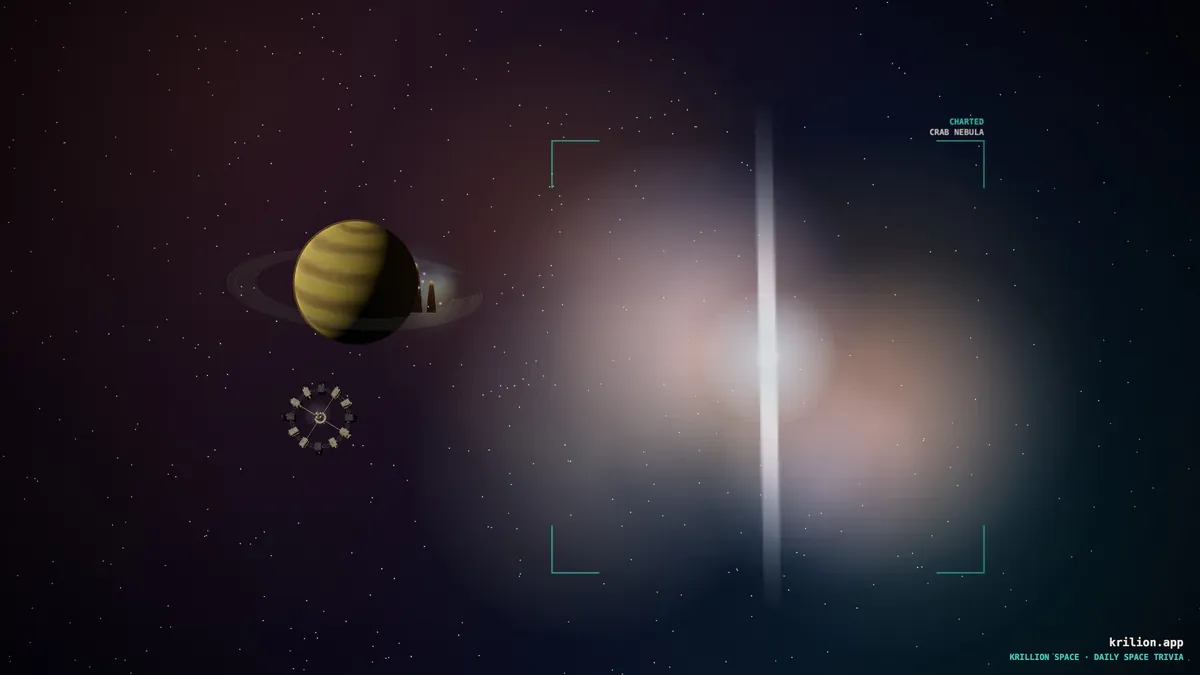
The Crab Nebula is the expanding debris of a star that exploded as a supernova seen from Earth in 1054. At its heart is a pulsar, a city-sized neutron star spinning about 30 times a second, which energises the surrounding cloud and makes it one of the most studied objects in the sky.
Fact sheet
- Type
- Supernova remnant and pulsar wind nebula
- Distance
- About 6,500 light-years from Earth
- Size
- About 6 light-years across
- Constellation
- Taurus
- Position in the sky
- Right ascension 5h 35m, declination +22° 01′
- Seeing it from Earth
- At about magnitude 8.4 it is too faint for the naked eye but can be found with a small telescope, and NASA lists January as the best month to look.
- On the voyage
- Depth 37, in the Milky Way section of the route, between the Ring Nebula and the Eagle Nebula
Things to know
- Chinese astronomers recorded the 1054 supernova as a 'guest star' that could be seen in daylight for nearly a month. NASA
- English astronomer John Bevis found the nebula in 1731, and Charles Messier's later sighting of it, which he first took for a comet, prompted him to start his famous catalogue. NASA
- The central pulsar is a neutron star only about 20 km (12 miles) wide that rotates about 30 times per second and pours out roughly 100,000 times the Sun's energy. NASA Chandra
- Comparing Hubble images taken about 25 years apart shows the nebula's filaments moving outward at about 5.5 million km per hour. ESA/Hubble
- Webb's measurements of nickel and iron suggest the explosion may have been a weak iron-core collapse, not only the rarer electron-capture type that earlier studies favoured. NASA
Sources
- NASA – Messier 1 (The Crab Nebula)
- Chandra – Crab Nebula fact sheet
- ESA/Hubble – Hubble revisits Crab Nebula to track 25 years of expansion (heic2607)
- NASA – Investigating the Origins of the Crab Nebula With NASA's Webb
Reach depth 37 on a voyage to fly past the Crab Nebula yourself. Every right answer warps your ship one stop deeper.
Play Krillion Space