
Depth 41 · Stellar black hole
Cygnus X-1
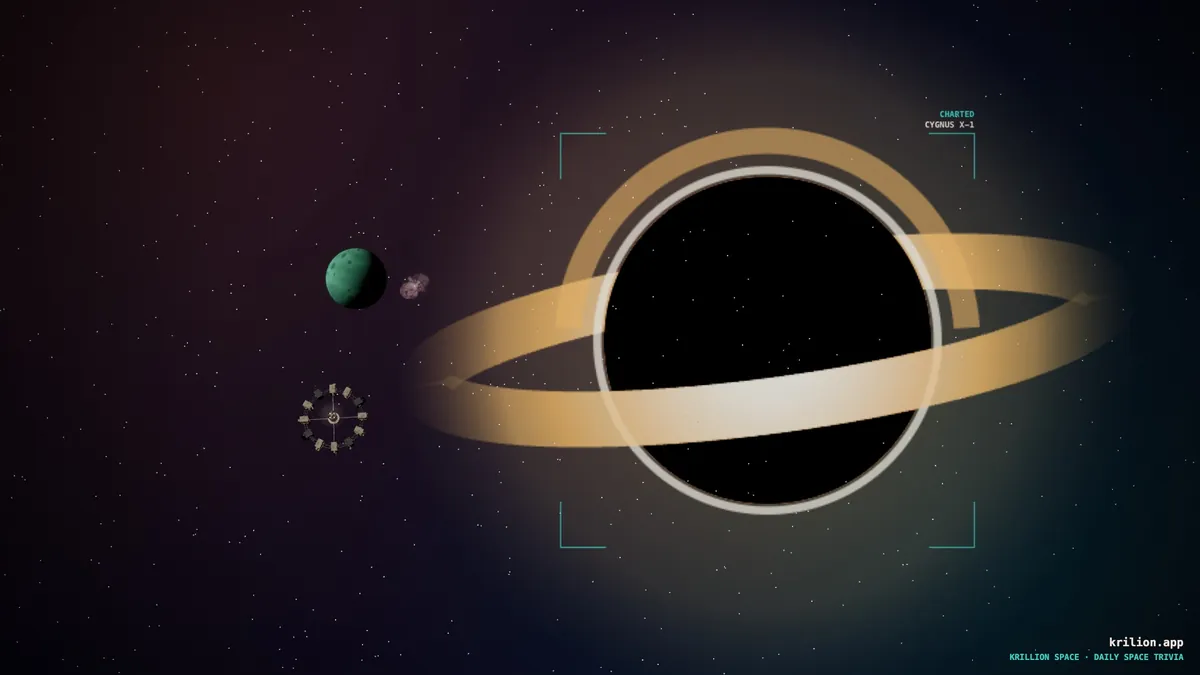
Cygnus X-1 is a black hole orbiting a huge blue supergiant star, pulling gas off its partner and heating it until it shines in X-rays. It was the first black hole to be widely accepted as real, and a 2021 study found it is farther away and heavier than earlier thought.
Fact sheet
- Type
- Black hole X-ray binary
- Distance
- About 7,200 light-years from Earth
- Size
- About 21 times the mass of the Sun
- Constellation
- Cygnus
- Position in the sky
- Right ascension 19h 58m, declination +35° 12′
- Seeing it from Earth
- The black hole itself cannot be seen with the eye or a backyard telescope; it is detected through the X-rays given off by gas it pulls from its companion star.
- On the voyage
- Depth 41, in the Milky Way section of the route, between the Eagle Nebula and Eta Carinae
Things to know
- A 2021 radio study measured the system's distance as about 2.2 kiloparsecs (about 7,200 light-years), which raised the black hole's mass estimate to about 21 times the Sun's. arXiv
- A companion 2021 study put the partner star at about 41 times the Sun's mass and found the black hole appears to be spinning close to the maximum possible rate. arXiv
- In 1974 Stephen Hawking bet physicist Kip Thorne that Cygnus X-1 did not contain a black hole, and he conceded the bet in 1990. NASA Chandra
- NASA describes Cygnus X-1 as the first black hole ever confirmed. NASA
Sources
- Miller-Jones et al. 2021, Science – Cygnus X-1 contains a 21-solar mass black hole (arXiv:2102.09091)
- Neijssel et al. 2021 – Wind mass-loss rates of stripped stars inferred from Cygnus X-1 (arXiv:2102.09092)
- Chandra – NASA's Chandra Adds to Black Hole Birth Announcement (2011)
- NASA Night Sky Network – Summer Triangle Corner: Deneb
Reach depth 41 on a voyage to fly past Cygnus X-1 yourself. Every right answer warps your ship one stop deeper.
Play Krillion Space