
Depth 43 · Hypergiant star
Eta Carinae
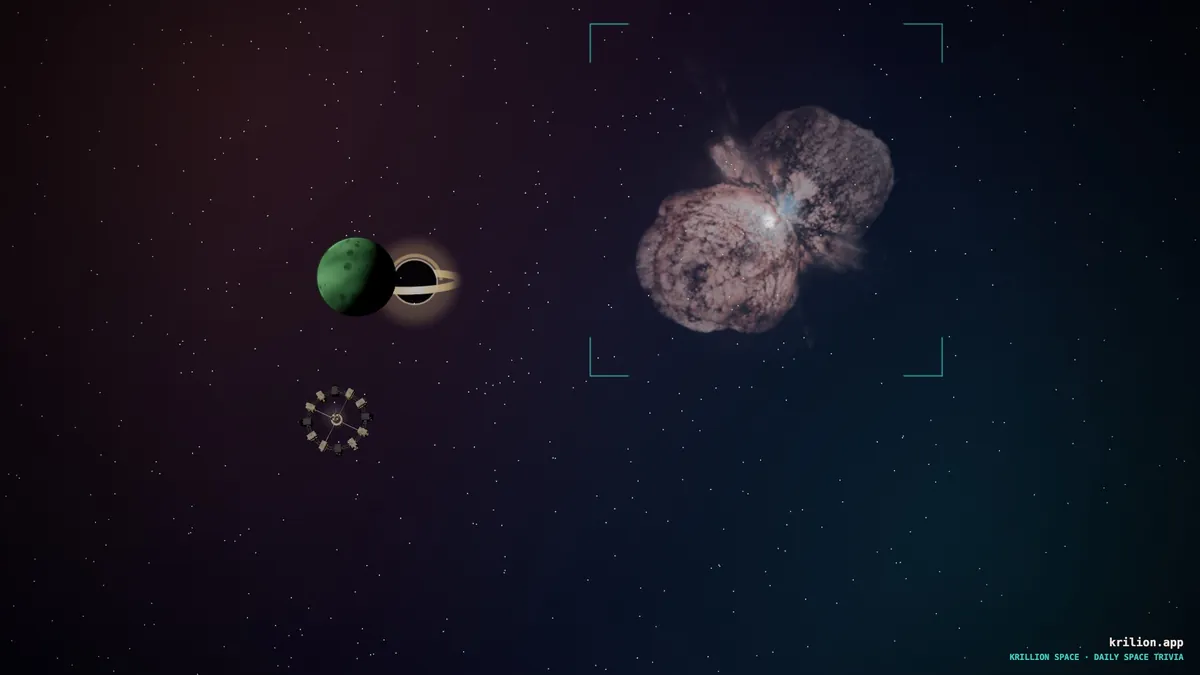
Eta Carinae is a pair of extremely massive, brilliant stars wrapped in a glowing cloud they blew out in a giant outburst in the 1840s. It is the most luminous and massive star system within about 10,000 light-years of Earth, and astronomers still cannot fully explain what caused its great eruption.
Fact sheet
- Type
- Massive binary star system
- Distance
- About 7,500 light-years from Earth
- Size
- Two stars of about 90 and 30 times the Sun's mass, inside a gas cloud about a light-year long
- Constellation
- Carina
- Position in the sky
- Right ascension 10h 45m, declination −59° 41′
- Seeing it from Earth
- Today it is barely visible to the naked eye and lies far south in the sky (declination about -60 degrees), so it is best seen from the Southern Hemisphere.
- On the voyage
- Depth 43, in the Milky Way section of the route, between Cygnus X-1 and Sagittarius A*
Things to know
- Its two stars swing unusually close together every 5.5 years, coming within about 225 million km of each other. NASA
- The larger star is roughly 90 times the Sun's mass and about 5 million times as luminous. NASA
- During its 'Great Eruption' in the 1840s, Eta Carinae became the second-brightest star in the sky for more than a decade before fading from naked-eye view. NASA
- That outburst built the two-lobed Homunculus Nebula, now about a light-year long and holding enough material to make at least ten Suns. NASA
- Astronomers have caught light from the Great Eruption only now reaching Earth after bouncing off distant dust, letting them study the outburst about 170 years after it was first seen. NASA
Sources
- NASA – NASA Observatories Take an Unprecedented Look into Superstar Eta Carinae
- NASA – Hubble Captures the Galaxy's Biggest Ongoing Stellar Fireworks Show
- Chandra – Eta Carinae (2023)
- NASA – Astronomers Watch Delayed Broadcast of a Powerful Stellar Eruption
Reach depth 43 on a voyage to fly past Eta Carinae yourself. Every right answer warps your ship one stop deeper.
Play Krillion Space