
Depth 31 · Red supergiant
Betelgeuse
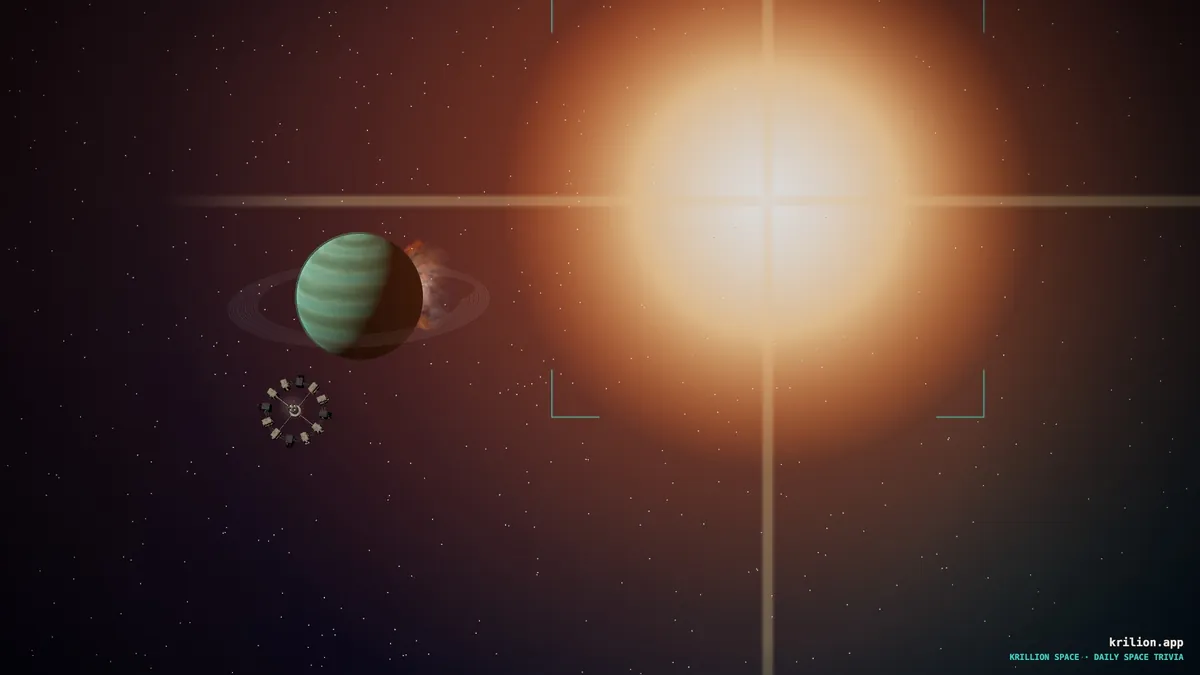
Betelgeuse is a huge, cool red supergiant marking a shoulder of Orion and the closest star of its kind to Earth. It is near the end of its short life and will someday explode as a supernova, and in recent years it surprised astronomers with a dramatic dimming and the probable detection of a close companion star.
Fact sheet
- Type
- Red supergiant (semiregular variable star)
- Distance
- Roughly 550 light-years from the Sun (estimates range from about 500 to 720)
- Size
- Roughly 700 to 760 times the Sun's radius and about 15 to 19 times its mass
- Constellation
- Orion
- Position in the sky
- Right ascension 5h 55m, declination +7° 25′
- Seeing it from Earth
- Easy to see with the naked eye from almost everywhere as the orange-red star at Orion's shoulder, best in the evening sky from about December to March (northern winter, southern summer).
- On the voyage
- Depth 31, in the Milky Way section of the route, between the Pleiades and the Orion Nebula
Things to know
- If Betelgeuse took the Sun's place, its surface would reach beyond the orbit of Jupiter. NASA
- Starting in late 2019, Betelgeuse lost about 60% of its brightness within a few months, then recovered by April 2020, an episode called the Great Dimming. NASA
- Hubble and other observatories traced the dimming to a huge eruption from the star's surface that cooled into a light-blocking dust cloud with several times the mass of our Moon. NASA
- In 2025 astronomers using the 'Alopeke camera on Gemini North reported a probable faint companion star of about 1.5 solar masses orbiting only about four Earth-Sun distances from Betelgeuse's surface; it has been nicknamed Siwarha and should be easiest to check again in November 2027. NOIRLab
- Although it is only about 10 million years old, Betelgeuse is expected to explode as a supernova in about 100,000 years, leaving a neutron star or black hole. NASA
Sources
- NASA Science – What Is Betelgeuse? Inside the Strange, Volatile Star
- NASA Science (Hubble) – Hubble Sees Red Supergiant Star Betelgeuse Slowly Recovering After Blowing Its Top
- NOIRLab – Gemini North Discovers Long-Predicted Stellar Companion of Betelgeuse (noirlab2523)
- Joyce et al. 2020, ApJ – New mass and distance estimates for Betelgeuse (arXiv)
Reach depth 31 on a voyage to fly past Betelgeuse yourself. Every right answer warps your ship one stop deeper.
Play Krillion Space