
Depth 33 · Stellar nursery
Orion Nebula
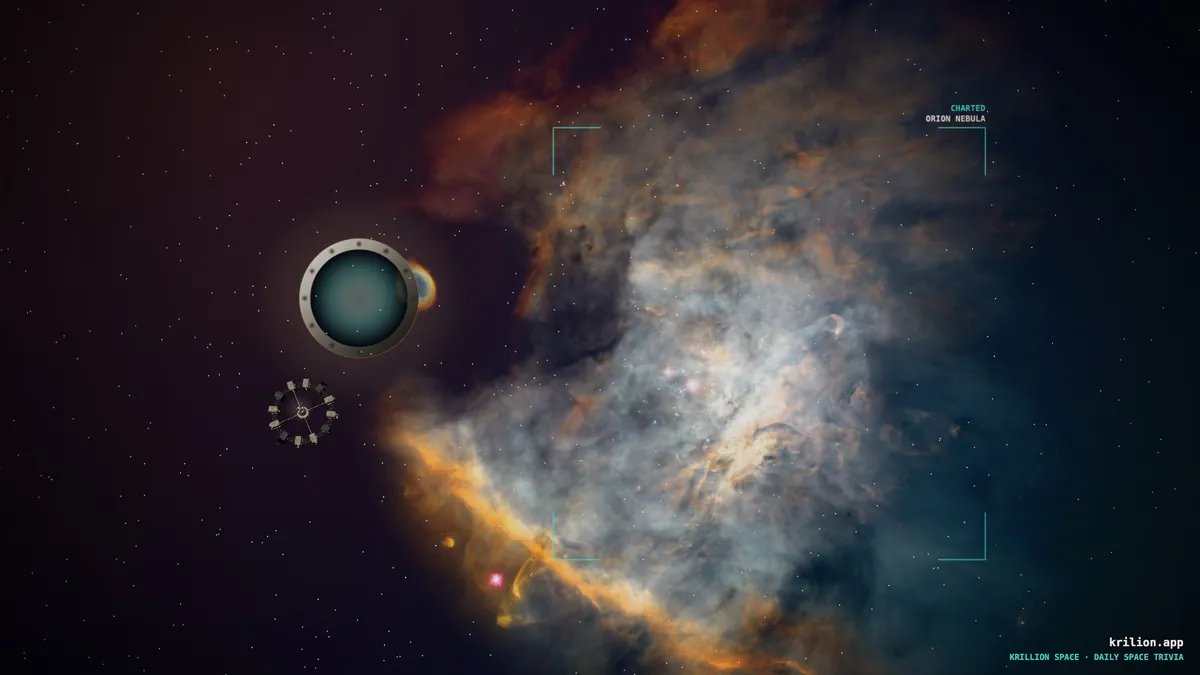
The Orion Nebula is a glowing cloud of gas and dust in Orion's sword and the closest large region of massive star formation to Earth. Hundreds of young stars, many brown dwarfs and planet-forming disks make it one of the best places to watch stars being born.
Fact sheet
- Type
- Emission nebula (H II region) around a young star cluster
- Distance
- About 1,300 light-years from the Sun (estimates range from about 1,270 to 1,350)
- Size
- About 24 light-years across
- Constellation
- Orion
- Position in the sky
- Right ascension 5h 35m, declination −5° 23′
- Seeing it from Earth
- Visible to the naked eye from a reasonably dark site as a fuzzy patch below Orion's belt, best in the evening sky around January (northern winter); binoculars or a small telescope show the glowing gas and the Trapezium stars.
- On the voyage
- Depth 33, in the Milky Way section of the route, between Betelgeuse and the Ring Nebula
Things to know
- The nebula is the nearest large star-forming region to Earth, and at its heart sits the Trapezium, four massive young stars whose ultraviolet light shapes the cloud. NASA
- Deep infrared images from ESO's Very Large Telescope released in 2016 revealed about ten times as many brown dwarfs and planet-sized free-floating objects as had been known there. ESO
- Hubble's sharpest view of the nebula was stitched together from 520 separate exposures and holds more than a billion pixels. NASA
- The James Webb Space Telescope has studied the Orion Bar, a ridge where ultraviolet light from the Trapezium eats into dense gas, and found a planet-forming disk there called d203-506. NASA
- You can find it with your eyes alone as a fuzzy patch in Orion's sword, just below the three stars of the belt. NASA
Sources
- NASA Science (Hubble) – Messier 42 (The Orion Nebula)
- ESO – Deepest Ever Look into Orion (eso1625)
- NASA Night Sky Network – A Flame in the Sky: The Orion Nebula
- Kuhn et al. 2019, ApJ – Kinematics in Young Star Clusters and Associations with Gaia DR2 (arXiv)
Reach depth 33 on a voyage to fly past the Orion Nebula yourself. Every right answer warps your ship one stop deeper.
Play Krillion Space