
Depth 29 · Star cluster
Pleiades
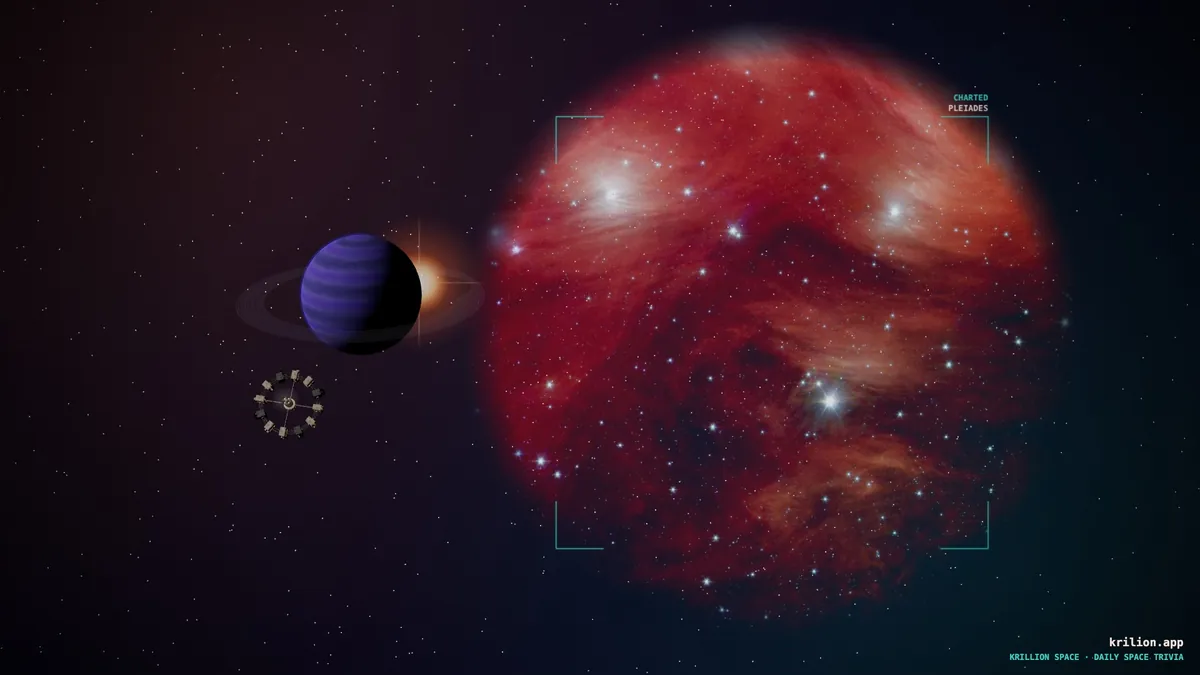
The Pleiades, or Seven Sisters, is a young cluster of more than a thousand stars in Taurus and one of the most recognizable sights in the night sky. Its distance was the subject of a long-running dispute that Gaia data helped settle.
Fact sheet
- Type
- Open star cluster
- Distance
- About 440 light-years from the Sun
- Size
- The gravitationally bound core is about 23 parsecs (about 75 light-years) across, based on a tidal radius of about 11.6 parsecs
- Constellation
- Taurus
- Position in the sky
- Right ascension 3h 47m, declination +24° 07′
- Seeing it from Earth
- Easily seen with the naked eye from both hemispheres as a small, tight group of stars in Taurus, best in the evening sky around December; binoculars show many more members.
- On the voyage
- Depth 29, in the Milky Way section of the route, between TRAPPIST-1e and Betelgeuse
Things to know
- The Pleiades holds more than a thousand loosely bound stars, but a handful of bright blue members give the cluster its familiar look. NASA
- People have watched the cluster since ancient times, and Galileo was the first to look at it through a telescope. NASA
- Hipparcos data published in 1997 put the cluster about 10% closer than other methods suggested, which started a long debate. ESA
- Most methods, including radio measurements in 2014, put the cluster 130 to 140 parsecs away, and a 2019 Gaia analysis gave 135 parsecs, siding against the Hipparcos value of about 120. arXiv
- A Hubble image shows a dusty cloud near the star Merope being broken apart by the star's radiation. NASA
Sources
- NASA Science (Hubble) – Messier 45 (The Pleiades)
- Lodieu et al. 2019, A&A – A 5D view of the Alpha Per, Pleiades, and Praesepe clusters (arXiv)
- Melis et al. 2014, Science – A VLBI resolution of the Pleiades distance controversy (arXiv)
- ESA Hipparcos – Pleiades distance
Reach depth 29 on a voyage to fly past the Pleiades yourself. Every right answer warps your ship one stop deeper.
Play Krillion Space