

Depth 61 · Compact galaxy group
Stephan's Quintet
Stephan's Quintet is a group of five galaxies in the constellation Pegasus, four of which are caught up in a cosmic dance about 290 million light-years away. In July 2022 it was among the first images from the James Webb Space Telescope, which revealed shock waves and long tails of gas, dust and stars pulled out by the encounters.
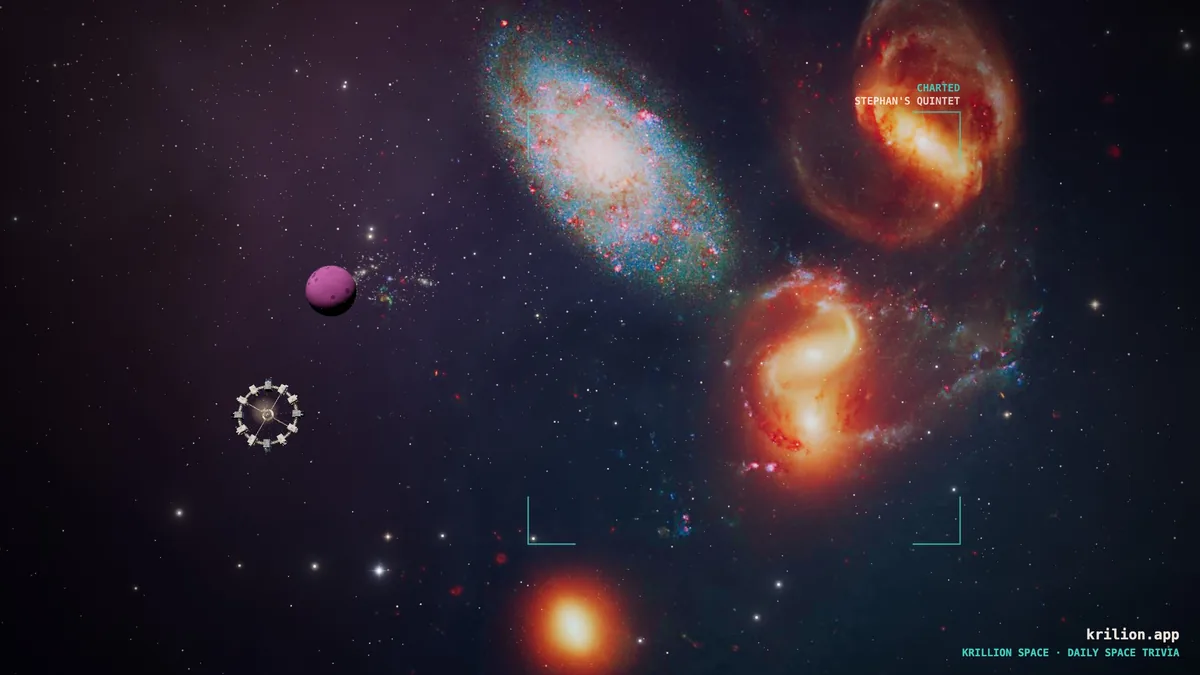
Fact sheet
- Type
- Compact galaxy group
- Distance
- About 290 million light-years for the four interacting galaxies; the fifth, NGC 7320, is only about 40 million light-years away
- Size
- Five galaxies close together on the sky; the shock wave rippling through the four true members is larger than our whole Milky Way
- Constellation
- Pegasus
- Position in the sky
- Right ascension 22h 36m, declination +33° 58′
- Discovered
- Discovered by the French astronomer Édouard Stephan in 1877.
- Seeing it from Earth
- It is far too faint for the naked eye; under dark skies a large amateur telescope shows its brightest galaxies as dim smudges in Pegasus, but its detail needs observatory or space telescopes.
- On the voyage
- Depth 61, in the Distant universe section of the route, between M87* and the Bullet Cluster
Things to know
- Édouard Stephan spotted it in 1877, making it the first compact group of galaxies ever discovered. NASA
- Only four of the five galaxies are truly together: NGC 7320 sits in the foreground about 40 million light-years away, while the other four are about 290 million light-years away. NASA
- Webb's mosaic of the group covers about one-fifth of the Moon's diameter, holds over 150 million pixels and was built from almost 1,000 separate image files. NASA
- The galaxy NGC 7319 hides a supermassive black hole 24 million times the mass of the Sun, which gives off as much light energy as 40 billion Suns. NASA
- The intruder galaxy NGC 7318B is passing through the group at about 3 million km/h (almost 2 million mph), and the shock wave it drives heats gas until it glows in X-rays. NASA Chandra
Stephan's Quintet trivia
Test yourself, then open each answer. Today's transmission has more.
What kind of object is Stephan's Quintet?
Compact galaxy group
How far away is Stephan's Quintet?
About 290 million light-years for the four interacting galaxies; the fifth, NGC 7320, is only about 40 million light-years away
When was Stephan's Quintet discovered?
Discovered by the French astronomer Édouard Stephan in 1877.
Which constellation is Stephan's Quintet in?
Pegasus
Sources
- NASA – NASA's Webb Sheds Light on Galaxy Evolution, Black Holes
- NASA – Galactic Wreckage in Stephan's Quintet
- ESA/Webb – Webb's First Images
- NASA JPL – A Shocking Surprise in Stephan's Quintet (PIA02587)
Reach depth 61 on a voyage to fly past Stephan's Quintet yourself. Every right answer warps your ship one stop deeper.
Play Krillion Space