

Depth 67 · Most distant galaxy
MoM-z14
MoM-z14 is the most distant galaxy confirmed so far, seen as it was only about 280 million years after the Big Bang. Webb confirmed its redshift of 14.44 in 2025, and it turned out brighter, more compact and richer in nitrogen than astronomers expected for so young a galaxy.
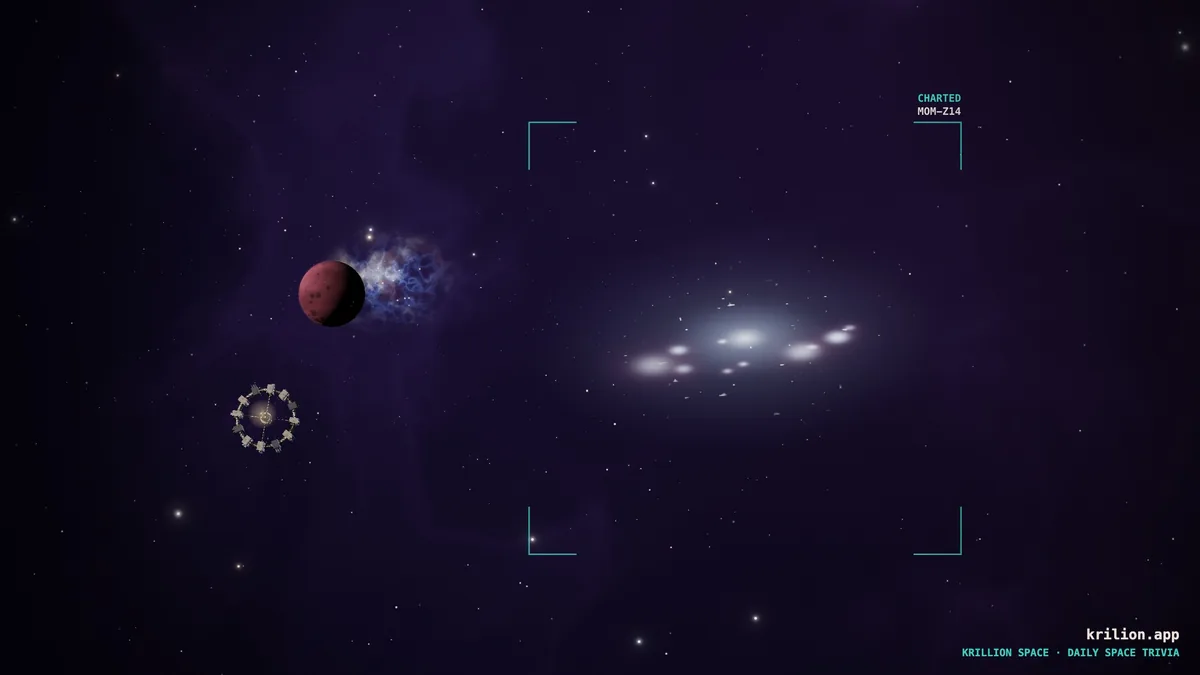
Fact sheet
- Type
- Early galaxy
- Distance
- Its light has travelled about 13.5 billion years to reach us (redshift 14.44), so we see it as it was about 280 million years after the Big Bang; space has expanded since, so the galaxy is now much farther away
- Size
- Very compact: half of its light comes from within about 240 light-years (74 parsecs) of its centre
- Constellation
- Sextans
- Position in the sky
- Right ascension 10h 01m, declination +2° 16′
- Discovered
- Confirmed in 2025 by the Mirage or Miracle survey, led by Rohan Naidu (MIT) and Pascal Oesch (University of Geneva), using Webb's NIRSpec spectrograph.
- Seeing it from Earth
- It is far too faint and too redshifted for any telescope on the ground; it shows up only in deep infrared images from the James Webb Space Telescope, in the COSMOS field in Sextans.
- On the voyage
- Depth 67, in the Distant universe section of the route, between TON 618 and the Cosmic Microwave Background
Things to know
- Webb's NIRSpec spectrograph confirmed its redshift of 14.44 in April 2025, beating the previous record holder, JADES-GS-z14-0, at 14.18. arXiv
- Its light has been travelling for about 13.5 billion of the universe's 13.8 billion years, so we see it as it was about 280 million years after the Big Bang. NASA
- Its name comes from the Mirage or Miracle (MoM) survey, which tests whether the surprising number of bright galaxy candidates in the early universe is an illusion or real. arXiv
- Like some of the Milky Way's oldest stars it is rich in nitrogen, which may mean the dense early universe made supermassive stars. NASA
- Webb is finding about 100 times more bright early galaxies like it than theories predicted before the telescope launched. NASA
MoM-z14 trivia
Test yourself, then open each answer. Today's transmission has more.
What kind of object is MoM-z14?
Early galaxy
How far away is MoM-z14?
Its light has travelled about 13.5 billion years to reach us (redshift 14.44), so we see it as it was about 280 million years after the Big Bang; space has expanded since, so the galaxy is now much farther away
When was MoM-z14 discovered?
Confirmed in 2025 by the Mirage or Miracle survey, led by Rohan Naidu (MIT) and Pascal Oesch (University of Geneva), using Webb's NIRSpec spectrograph.
Which constellation is MoM-z14 in?
Sextans
Sources
- NASA – NASA Webb Pushes Boundaries of Observable Universe Closer to Big Bang
- Naidu et al. 2026, Open Journal of Astrophysics – A Cosmic Miracle: A Remarkably Luminous Galaxy at z = 14.44 Confirmed with JWST (arXiv:2505.11263)
- ESA/Hubble – The full COSMOS field (UltraVISTA)
Reach depth 67 on a voyage to fly past MoM-z14 yourself. Every right answer warps your ship one stop deeper.
Play Krillion Space