
Depth 23 · Binary star
Sirius
Sirius, the Dog Star, is the brightest star in the night sky, a hot white star paired with a faint white dwarf called Sirius B. Sirius B packs about the Sun's mass into a body smaller than Earth, which made it a key test case for the physics of dead stars.
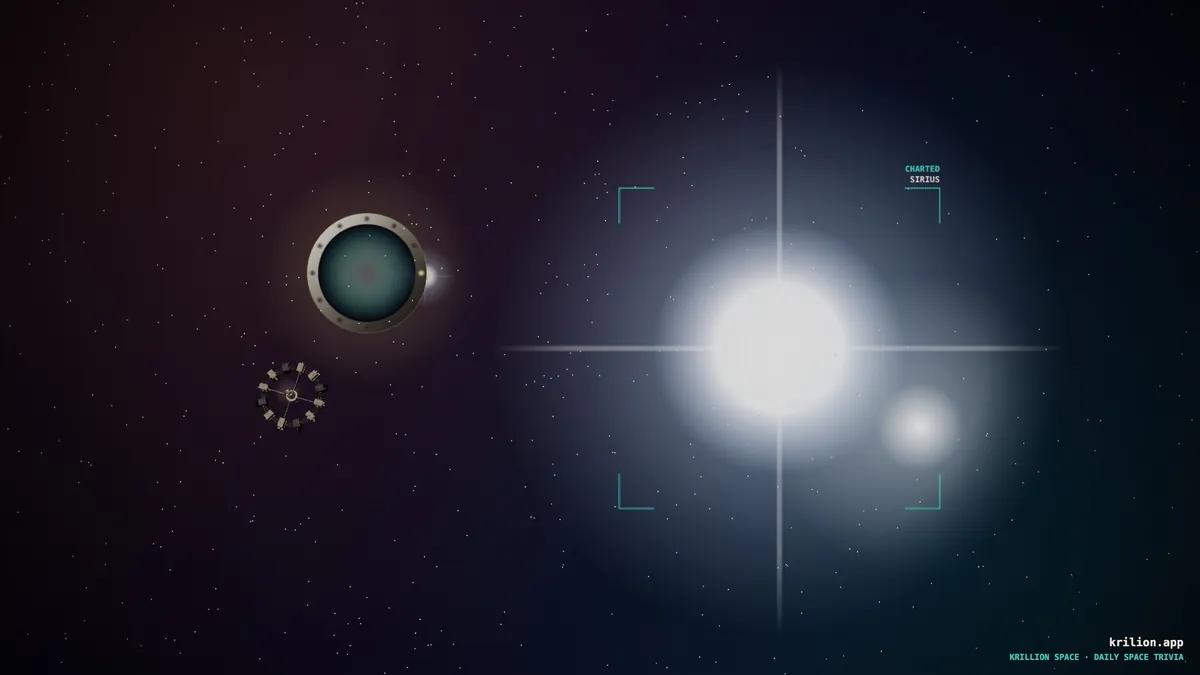
Fact sheet
- Type
- Binary star (A-type main-sequence star and white dwarf)
- Distance
- About 8.6 light-years from the Sun
- Size
- Sirius A is about 1.7 times the Sun's radius and about twice its mass; Sirius B has about the Sun's mass in a body slightly smaller than Earth
- Constellation
- Canis Major
- Position in the sky
- Right ascension 6h 45m, declination −16° 43′
- Seeing it from Earth
- Easy to see with the naked eye from almost anywhere on Earth as the brightest star of the night, best in the evening sky during northern winter (southern summer); Sirius B is very hard to spot even with a good telescope because of A's glare.
- On the voyage
- Depth 23, in the Nearby stars section of the route, between Barnard's Star and Vega
Things to know
- In 1844 Friedrich Bessel noticed that Sirius wobbles as it moves and concluded it must have an unseen companion; Alvan Graham Clark and his father, Alvan Clark, finally saw Sirius B through a telescope in 1862. arXiv
- The two stars orbit each other about once every 50 years, and Sirius B is roughly 10,000 times fainter than Sirius A in visible light. NASA
- Hubble weighed Sirius B by measuring how its strong gravity stretches its light toward redder wavelengths, an effect predicted by Einstein, and found about 98% of the Sun's mass. ESA
- Sirius B is only about 12,000 kilometres across, so the gravity at its surface is hundreds of thousands of times stronger than on Earth. ESA
- In X-ray light the roles flip: the hot white dwarf Sirius B outshines its much bigger partner. NASA Chandra
Sources
- NASA Science (Hubble) – The Dog Star, Sirius, and its Tiny Companion
- ESA – 'Weighing' the Dog Star's companion
- Chandra X-ray Observatory – Sirius A & B
- Bond et al. 2017, ApJ – The Sirius System and its Astrophysical Puzzles (arXiv)
Reach depth 23 on a voyage to fly past Sirius yourself. Every right answer warps your ship one stop deeper.
Play Krillion Space