
Depth 17 · Triple star system
Alpha Centauri
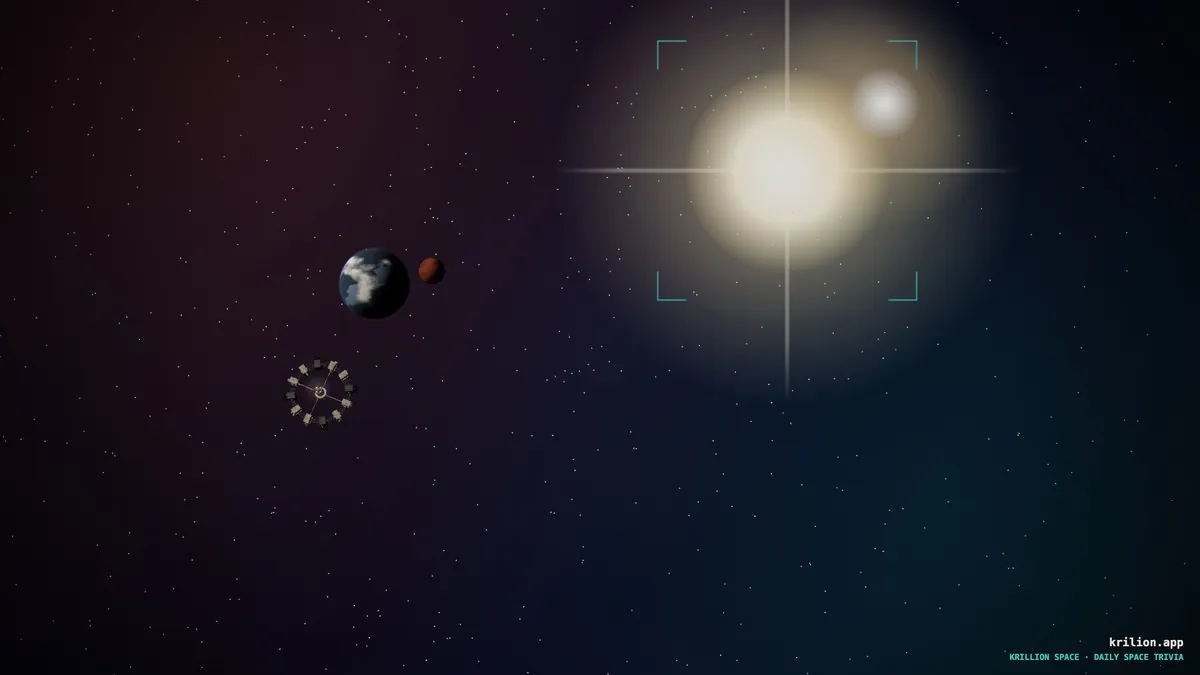
Alpha Centauri is the closest star system to the Sun: a pair of Sun-like stars, A and B, with a small red dwarf, Proxima Centauri, circling far outside them. Because A and B are so similar to the Sun and so close to us, they are prime targets in the search for planets and life beyond the solar system.
Fact sheet
- Type
- Triple star system (G-type and K-type main-sequence stars plus a red dwarf)
- Distance
- About 4.3 light-years from the Sun (the A and B pair)
- Size
- Alpha Centauri A is about 1.2 times the Sun's radius and 1.08 times its mass; Alpha Centauri B is about 0.86 times the Sun's radius and 0.91 times its mass
- Constellation
- Centaurus
- Position in the sky
- Right ascension 14h 40m, declination −60° 50′
- Seeing it from Earth
- Easily seen with the naked eye as one bright star from the Southern Hemisphere and low northern latitudes; it never rises for most of the Northern Hemisphere, and splitting A from B needs a small telescope.
- On the voyage
- Depth 17, in the Nearby stars section of the route, between the Oort Cloud and Proxima Centauri b
Things to know
- The system has three stars: Alpha Centauri A is a G-type star a little heavier than the Sun, B is a slightly cooler K-type star a little lighter than the Sun, and Proxima Centauri is a small red dwarf. NASA
- Alpha Centauri A and B circle each other about once every 80 years, while Proxima orbits the pair from more than 10,000 times the Earth-Sun distance. NASA Chandra
- Proxima is currently the single closest star to the Sun, with the A and B pair a very close second. NASA Chandra
- In 2024 the James Webb Space Telescope spotted a possible Saturn-mass gas giant orbiting Alpha Centauri A, but follow-up looks in 2025 did not see it again, so it remains an unconfirmed candidate. ESA/Webb
- Alpha Centauri A ranks as the third-brightest star in the night sky, and the system lies so far south that it is seen mainly from the Southern Hemisphere. ESA/Webb
Sources
- NASA Goddard SVS – Alpha Centauri Stellar System
- Chandra X-ray Observatory – Alpha Centauri (2018)
- ESA/Webb – Webb finds new evidence for planet around closest solar twin (weic2515)
- Akeson et al. 2021, AJ – Precision millimeter astrometry of the Alpha Centauri AB system (arXiv)
Reach depth 17 on a voyage to fly past Alpha Centauri yourself. Every right answer warps your ship one stop deeper.
Play Krillion Space